Friday, May 29, 2009

Announcement of farmers accompaniment action

Saturday, 30 May 2009: Five international human rights workers from the ISM-Gaza Strip will be accompanying farmers from Khoza’a as they harvest crops next to the Green Line.

In the morning, human rights workers will join Palestinian farmers in Khoza’a village, located east of Khan Younis in the southern Gaza Strip, to farm land 400 meters from the ‘Green Line’.


Several farmers have been shot by Israeli forces while farming their lands.

Israeli attack in Letaemat, Gaza Strip 7/5/2009

Farmers Under Fire

A compilation video from real incidents filmed by ISM Gaza Strip volunteers of Palestinian farmers coming under fire from Israeli soldiers shooting with live ammunition from jeeps and towers along the border to Gaza. All of the incidents occurred in the south-eastern border region east of Khan Younis, within the months since the 'cease-fire' following Israel's war on Gaza. All the attacks have been against unarmed Palestinian farmers, including women and children, and internationals accompanying them. The practise of firing at farmers and civilians in the area up to 1km from the border has been a consistent occurrence, with attacks increasing after Israel's 3 weeks of massacring Gaza. The farmers working the land are all either dependent on the food they produce or very poor labourers dependent on the meagre salary they receive. Most have no other options for work or farming. These attacks come hand in hand with Israel's declaring the 300 m to the border as 'off limits', Israel's policy of razing agricultural land and destroying farms, farm equipment, greenhouses, and crops, and the siege on Gaza which has crippled all sectors of life within the Strip. see Farming Under Fire for more incidents and information: http://farmingunderfire.blogspot.com/

« Operation Cast Lead »: Dozens of Tonnes of Depleted Uranium and other radioactive substances were spread across the Gaza Strip

Friday 22 May 2009

ACDN Media Release, 22 May 2009

In the Gaza Strip between 27 December 2008 and 18 January 2009, the Israeli army conducted a ground and air offensive nicknamed « Operation Cast Lead ».

During the first few days a Norwegian doctor doing humanitarian service in the hospital at Shifa, Dr Mads Gilbert, denounced the presence of radioactive matter, possibly Depleted Uranium, in the bodies of victims. On 4 January 2009, after investigation, ACDN (Action of Citizens for the total Dismantling of Nukes) alerted the press and public opinion with a media release: « In Gaza, the genocide with Depleted Uranium has begun, using GBU-39 bombs provided by the USA ».

This accusation has now emerged with greater strength after several months of investigation carried out in close liaison with the people concerned and with the help of Jean-François Fechino, a consultant on diffuse pollution and an expert accredited to the UN Environment (UNEP). ACDN has just produced a 33-page report concluding that the presence of dozens of tonnes of Depleted Uranium (perhaps as much as 75 tonnes) in the soil and subsoil of Gaza is highly probable.

In April 2009, a four-person mission including Jean-François Fechino went to Gaza under the auspices of the Arab Commission for Human Rights. The samples of earth and dust that they brought back from Gaza were then analysed by a specialist laboratory, which found in them elements of Depleted Uranium (which is radioactive, carcinogenic, teratogenic), particles of Cesium (which is radioactive and carcinogenic), asbestos dust (which is carcinogenic), Volatile Organic Compounds (VOCs, which are fine particles which endanger health, especially the health of children, asthmatics and old people), phosphates (from oxidation of white phosphorus), tungsten (which is carcinogenic), copper, aluminium oxide (which is carcinogenic), and Thorium Oxide (ThO2, which is radioactive)...

The detailed results will soon be made public. Journalists or other persons wishing to learn more are invited to contact ACDN or visit its Website www.acdn.net.


Israel used depleted uranium in offensive on Gaza


weapons_uraniomGaza, May 24, (Pal Telegraph) - Action of Citizens for the total Dismantling of Nukes (ACDN) said Saturday that it has just produced a 33-page report concluding that the presence of as much as 75 tons of depleted uranium in Gaza soil is highly probable to the Israeli "Operation Cast Lead" offensive.

The operation took place between December 27, 2008 and January 18, 2009.

During the first few days, a Norwegian doctor doing humanitarian service in the hospital at Shifa, Dr Mads Gilbert, denounced the presence of radioactive matter, possibly depleted uranium, in the bodies of victims.

This accusation has now emerged with greater strength after several months of investigation carried out in close liaison with the people concerned and with the help of Jean-Francois Fechino, a consultant on diffuse pollution and an expert accredited to the UN Environment (UNEP).

In April 2009, a four-person mission including Fechino, went to Gaza under the auspices of the Arab Commission for Human Rights.

The samples of earth and dust that they brought back from Gaza were then analysed by a specialist laboratory, which found in them elements of depleted uranium (which is radioactive, carcinogenic, teratogenic), particles of cesium (which is radioactive and carcinogenic), asbestos dust (which is carcinogenic), volatile organic compounds (VOCs, which are fine particles which endanger health, especially the health of children, asthmatics and old people), phosphates (from oxidation of white phosphorus), tungsten (which is carcinogenic), copper, aluminium oxide (which is carcinogenic), and thorium oxide (ThO2, which is radioactive).

Wednesday, May 27, 2009

Israeli forces attempts to legitimize pre-meditated murder and land annexation

In Gaza

May 26, 2009, 3:51 pm
Filed under: the "buffer zone"

gaza

gaza1

“Life is hard for Palestinian farmers in the border region near Israel. The IOF shoot at us every day, any time. They shoot at the international volunteers (ISM) also.”

This was Jaber Abu Rjila testifying some of what he has experienced in the last decade on his land less than 500m from the border with Israel.

jaber

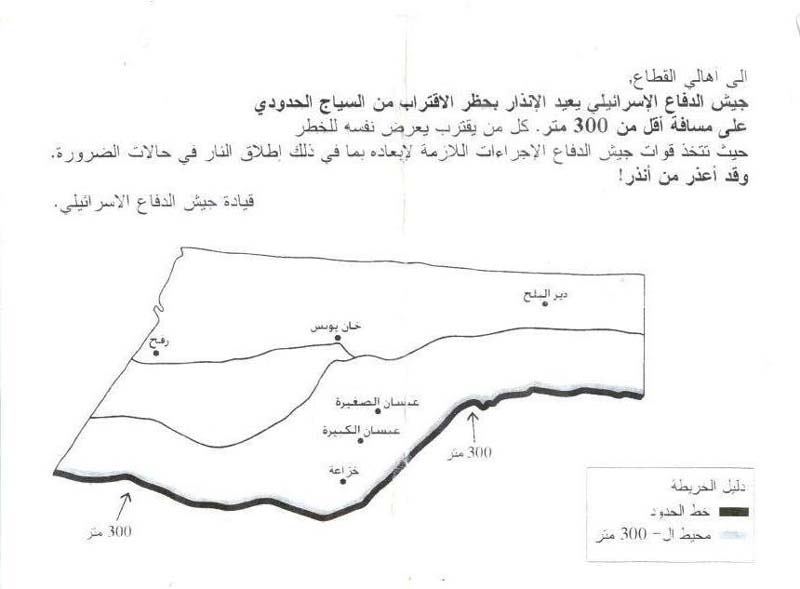
Yesterday, the day before Abu Rjila was interviewed, Israeli occupation forces dropped leaflets along the border area, from north to south, announcing Israel’s unilateral decision that the border area is off-limits and that, by dropping leaflets, Israeli soldiers have the right to shoot to kill anyone found within 300m of the fence. [see translation of the message at the bottom of the page]

Dropping leaflets to try to legitimize Israeli crimes is nothing new: during the 23 day massacre of Gaza, Israeli soldiers dropped leaflets announcing areas which were subject to mass-bombing, saying the residents must leave. Such action does not suddenly render international law insignificant, nor –even if legality were not a question –does it realistically afford the Palestinian civilians in question any option of alternate existence.

During the war, there was no place that people in Gaza felt safe, for good reason, as Israel bombed anything moving and any sanctuary. The leaflets were irrelevant.

As they are here. The farmers and civilians living in the so-called ‘buffer zone’ (Israel-designated; running only along the Palestinian side) have no options to relocate. Gaza, as one may recall, is an incredibly small and densely-populated strip. An incredibly impoverished strip, after the manufactured economical, employment, sanitation, health, nutrition, and education crises, to name just some.

The farmers and civilians living in the 500m to 1 km region along the border have in many cases worked this land for generations. For the majority, this is their only source of income, however meager that may be, particularly since Israel does not allow the export of goods formerly sent to European markets, like strawberries, fruit, carnations, all of which fetched impressive prices.

Those farmers who do not live on the land are working it as their only source of employment, taking home at best $5 a day, when they feel like risking their lives to work.

The Israeli declaration that they will shoot anyone in the border regions is nothing new: Israeli soldiers have been targeting Palestinians and the internationals who accompany them for years. Since the end of the war on Gaza, January 18, alone Israeli soldiers have killed at least 3 people in the border region, including a child, and have injured another 12, including 3 minors and 2 women.

Many of these injuries have occurred at distances greater than 300m, greater even than 500m, from the fence. The injured and killed have been clearly unarmed, visibly no threat to well-armed Israeli soldiers.

In our days accompanying farmers, we have seen Israeli soldiers park their military jeeps and hummers, observe the farmers for lengthy periods, and suddenly begin to shoot dangerously close to the farmers and to us. The soldiers have had ample time to count the number of people present, to watch our activities (the most dangerous aspect of which may be slicing parsley or some poor attempts at Dabke dancing in quieter moments).

Some incidents, recapped, to highlight just how these Israeli army aggressions affect and destroy Palestinians lives:

-Maher Abu-Rajileh (24) from Huza’ah village, east of Khan Younis, was killed by soldiers on January 18 when he returned with his parents and brother to farmland 400m from the Green Line following Israel’s announcement of a ceasefire. At 10 am, after he had spent two hours cleaning up the land from the destruction wreaked by Israeli bulldozers and tanks, Israeli soldiers opened fire, shooting Maher in the chest, killing him instantly.

-On Jan. 20, Israeli soldiers fired on residents of Al-Qarara, near Khan Younis, shooting Waleed Al-Astal (42) in his right foot.

-Soldiers opened fire on Khuza’a village, east of Khan Yunis, on Jan. 23, shooting Nabeel Al-Najjar (40) in the left hand.

-On Jan. 25, Israeli soldiers shot Subhi Qudaih (55) in the back while he was on Khuza’a village farmland.

-On Jan. 27, just outside of Al-Farahin, also east of Khan Younis, soldiers killed Anwar Al-Buraim (26), shooting him in the neck while he picked vegetables on land approximately 500m from the Green Line.

-On February 14th, at approximately 12:00, the body of Hammad Barrak Salem Silmiya, 13, from al-Qerem area east of Jabalia town in the northern Gaza Strip, was brought to Shifa’ Hospital in Gaza City. The child had been shot in the head. According to his family, IOF troops fired at him while he was herding animals in the east of Jabalia town.

-On Feb. 18, farmers returned to harvest land approximately 500 metres from the Green Line where Anwar Al-Buraim was shot dead weeks earlier. As the farm workers were leaving the land, Israeli soldiers targeted Mohammad Al- Buraim, a deaf 20-year-old and cousin of Anwar. Mohammad was with a group of approximately ten farmers pushing their stalled pick-up truck loaded with harvested produce when Israeli soldiers began sniping, hitting Mohammed in the right ankle and continuing to shoot as the farmers, surrounded by international human rights observers, moved away from the field and took shelter behind a nearby house.

-On February 24th, after shooting at farmers and internationals accompanying them in the morning, Israeli soldiers shot a 17 year old girl in the kneecap as she stood near her demolished home roughly 800m from the border. Her knee was completely shattered.

-On March 10th, at approximately 15:30, IOF troops positioned at the border between the Gaza Strip and Israel to the east of al-Maghazi refugee camp in the central Gaza Strip fired at Palestinian houses in the camp. As a result, Muhannad Sehi Abu Mandil, 24, was wounded by a gunshot to the left foot.

-On May 5th, 35-year-old Nafith Abu T’eima sustained light injuries following several gunshot volleys from a passing Israeli militarized jeep, and was hit in the neck with shrapnel. He was tending his lands at the time of the incident and evacuated to hospital.

-On May 7th, 32-year-old Randa Shaloufeh, was working her land near the Israeli-Gaza border when soldiers fired at her. She was shot in her chest and hand.

-On April 10th, a handicapped Palestinian woman, Leila Abu Dagga, was injured when she fell down the stairs from the roof of her house while she was fleeing Israeli soldiers’ gunfire.

And regarding the damage done to land, crops, equipment, and export:

-On May 4th, Israeli troops set fire to Palestinian crops ranging along a 4km stretch along the border. The Palestinian Centre for Human Rights (PCHR) reported that 200,000 square meters of crops were destroyed, including wheat and barley ready for harvest, as well as vegetables, olive and pomegranate trees.

-Ismail Abu Taima explained that over the course of the year he invests about $54,000 in planting, watering and maintenance of the monthly crops. From that investment, if all goes well and crops are harvested throughout the year, he can bring in about $10,000/month, meaning that he can pay off the investment and support the 15 families dependent on the harvest.

Ismail Abu Taima collected valves from the broken irrigation piping. The pipes themselves had been destroyed by a pre-war on Gaza invasion. “The plants have not been watered since one week before the war,” he’d told us. He collected the parts, each valve valuable in a region whose borders are sealed and where replacement parts for everything one could need to replace are unattainable or grossly expensive.

He’d also told us of the chicks in the chicken farm who’d first been dying for want of chicken feed, and then been bulldozed when Israeli soldiers attacked the house and building they were in.

-Abu Alaa lives in Khan Younis and owns land in the newly-extended “Buffer Zone”, the strip of land along the Green Line which, from North to South, cuts into Palestinian land by a full 1 km now.

Israel’s ongoing control of Gaza and its borders has meant that those farmers able to produce vegetables, fruit or flowers cannot export them. For the last 3 years, the flower and strawberry exports have near-completely ceased.

Whereas former years saw over 40 million flowers exported for sale in European markets, Israel finally deigned to allow out a fractional 25,000, much too little, much too late. Last year farmers fed flowers to their animals, in protest and frustration at the closed borders.

-At 2:30 pm January 17, 4 massive Israeli tanks and 1 towering military bulldozer accompanied a smaller military bulldozer and invading, occupying Israeli soldiers as they blazed towards Manwa’s, yelling through a megaphone, ordering them to get out of the house. Sharifa, 22, left first. Soldiers asked her if there were any men inside the house, to which she replied ‘no’. Manwa came next, also with hands in the air. The question was repeated, soldiers not believing the women could stay by themselves, telling the women as much.

It was 3 weeks after Israel’s Gaza-wide air-strikes began, and the fact that Manwa and Sharifa had stuck it out alone in that isolated area is incredible.

“They told me our house was now in a closed military zone,” Manwas said. “They said it was a ‘decision from the top’ and that we had to leave immediately and walk towards Gaza,” she said. “I refused, and tried to negotiate with them for time to gather our belongings. They refused.”

Manwa was a safe distance away, watching, when the Israeli soldiers bulldozed her house at 5 pm that day.

This was one day before Israel declared a ceasefire…

The flat fields around us once held olive, lemon and palm trees, Saber tells us. About 750 dunums (1 dunum=1000 square metres). “People from all over Gaza had jobs here. It is one of the best regions for agriculture in Gaza,” Saber goes on. He doesn’t need to spell out that all of the trees had been bulldozed, like the houses, over the years since 2003. We know, are aware of Israel’s policy of razing Palestinian land.

-accounts of various farmers in the ‘buffer zone’

translation of the flyer:

(on both sides the same writing but different maps)

to the people of the strip:

the israeli defence forces repeat their alert forbidding

the coming close to the border fence at a distance less than 300 metres

who gets close will subject himself to danger whererby the IDF will take necessary procedures to drive him away which will

include shooting when necessary

he who has alerted shall be excused!

-the IDF

DSC04093

*Palestinian home roughly 500m from the border with Israel, bearing the traces of various Israeli soldiers’ shooting incidents.

blood

*blood from Mohammed al Buraim, shot in the ankle by Israeli soldiers on February 18th.

Monday, May 25, 2009

The leaflets thrown by the Israeli aircrafts

translation:
(on both sides the same writing but different maps)
to the people of the strip:
the israeli defence forces repeat their alert forbidding
the coming close to the border fence at a distance less than 300 metres
who gets close will subject himself to danger whererby the IDF will take necessary procedures to drive him away which will
include shooting when necessary
he who has alerted shall be excused!
the IDF


Leaflets dropped on Gaza ordering citizens to stay away from border areas
[ 25/05/2009 - 08:12 PM ]

GAZA, (PIC)-- Israeli helicopters dropped on Monday morning thousands of leaflets ordering the Palestinians to stay away from border areas in the Gaza Strip, and threatening to open fire at any citizen approaching the borderlines.

The leaflets state that the Gaza people should not approach the electronic border fence, and should be at least 300 meters away from the fence or else they would be targeted by Israeli military fire.

Also, the leaflets include maps showing the areas that the Palestinians are not allowed to get near.

Warning leaflets were dropped over Beit Hanoun and Beit Lahia in the north, in addition to Al- Maghazi, Dir Al Balah and Abasan in Khan Younis, as well as all border areas in the Rafah area in the southern part of the Strip.

Many Gazans living near border areas will become homeless because they will have to leave their homes if Israel wages aerial attacks on the specified areas.

Press Release of Beit Hanoun Local Initiative about Israeli threats

Beit Hanoun, Gaza
During the early hours of the morning today, Monday May 25, 2009, the occupation forces dropped by their war planes a container with flyers which include statements that threaten to attack the Palestinians living in Beit Hanoun closest to the 1948 lands. The flyers stated that any civilian who gets 300 metres or less from the borders they will be shot. Previously, on the 27th of December 2008, the IOF had stated it will attack any civilian that is 1 km or less from the border.

The Beit Hanoun Local Initiative coordinator, Saber al Zaaneen, stated that this was an unjust unilateral decision by the occupation forces which directly affects the livelihoods of hundreds of Palestinians that work on their land, dependent on harvesting and plantation.
Zaaneen also stated that the occupation forces had directly shot at a group of volunteers near the borders on July 1, 2008, who had arranged for weekly demonstrations to occur. Despite the IOF targeting them, the volunteers persisted their way.
After the latest genocidal attacks against the Palestinian people, the IOF disallowed civilians, farmers and volunteers, from being 1 km or less from the borders, as well as destroying all homes, plantations and farmlands present within that distance.
Today's IOF decision of attacking anyone within 300 m from the borders is a farce, as they had already been doing so from the start, as well as disallowing farmers from getting to their lands. This is just another way that the occupation forces exercise their neo-colonialist tactics and operations.
The Beit Hanoun Local Initiative urges all people of good conscience to stand by the Palestinian people in those harsh cicumstances, in acts of solidairty and thereby enabling the volunteers to continue their work and support them as such.

Israeli planes drop warning pamphlets over Gaza

Ha’aretz

25 May 2009

Israel Air Force aircraft have scattered pamphlets over the Gaza Strip warning residents to stay away from the border, The Associated Press reported Monday.

The heavily guarded border is the scene of sporadic fighting between militants and Israel Defense Forces troops. Israeli forces killed two Palestinian gunmen in a clash on Friday.

The Arabic pamphlets warned Gazans to stay out of areas 300 meters to 500 meters from the border fence, saying they risk being shot.

The IDF had no comment. The military has scattered similar warning pamphlets in the past.

Gaza’s Health Ministry said a 10-year-old boy was struck by a box of leaflets and moderately hurt during Monday’s airdrop.

Violence has largely subsided in Gaza following Israel’s 3-week offensive against the coastal territory’s Hamas rulers in January

Israel warns Palestinians to stay away from Gaza border wall
Date: 25 / 05 / 2009 Time: 11:48

[Ma'anImages]
Bethlehem - Ma'an - Israel's air force used helicopters to drop fliers warning Palestinians to stay away from the Gaza border wall on Monday, residents.

"You have been warned. We urge residents of the Strip to keep a 300 meter distance from the fence," the fliers read.

Commenting on the message, a Gazan citizen told Ma’an, “Israel is seeking a new immigration of the Palestinians especially that the warning is not to passersby, but to residents living near the borderline. There are homes which are less than tens of meters away from the borderline, and there are agricultural lands close to the border fence.”

Twelve-year-old Muhammad Dughmush from the Tel Al-Hawa neighborhood of Gaza City was injured by a box of fliers dropped by Israeli choppers. According to Muawiya Hassanein, director of Ambulance and Emergency Services at the Palestinian Health Ministry, the boy received first aid at the Jordanian hospital before he was transferred to Ash-Shifa Hospital in Gaza City, suffering bruises along his back.

The fliers were dropped over the homes of residents in Beit Hanoun and Beit Lahiya in northern Gaza, Ynet said, as well near communities in the south and central regions near Khan Younis, Kerem Shalom and Rafah.

In a statement, the Israeli military confirmed that it dropped the leaflets, warning that it "will operate against all those who approach the fence, due to the threat that they pose to the civilians of the State of Israel."

Israeli leaflets warn Gazans to keep away from border


Gaza, May 25, 2009 (Ramattan) – Israeli aircraft on early Monday dropped flyers over the Palestinian Gaza Strip, warning the residents there to stay away from the security fence that separates between the Jewish state and the Hamas-controlled Strip.

The leaflets spread over the skies of northern Gaza Strip and eastern Gaza city, as well as in southern Gaza Strip towns of Khan Younis and Rafah.

"It is forbidden for anyone to go beyond a distance of 300 meters from the fence and the Israeli defense forces will take necessary measures to turn him away, including shooting when it is necessary," one of the leaflets read.

An initial map was drawn in black and grey on a white paper that showed the border fence and the buffer zone which stretched between the two ends of the Gaza Strip.

Israel used to keep no-go areas along its borders with the Gaza Strip since the beginning of the Palestinian uprising in 2000. However, the space of the buffer zones used to change according to the security situation.

The last time Israel dropped aerial warnings on Gaza was during the major three-week military offensive between December 2008 and January 2009.

Israel and the Islamic Hamas movement are not observing a ceasefire these days but each side maintains a level of relative quietness.


Sunday, May 24, 2009

Harvest in the Automated Kill Zone, Part 2 - Khoza'a 24/05/2009

Farming under fire & F16s (Khouza'a, Gaza Strip, 24/5/2009)

Israeli troops atacking Palestinian farmers accompanied by international human rights observers of ISM Gaza Strip. The farmers non violently resist the attacks and continue to harvest their fields (also despite the intimidation of F16 jets).