Showing posts with label declaration of "buffer zone". Show all posts

Thursday, March 17, 2011

F16s drop leaflets on northern Gaza

 
GAZA CITY (Ma'an) -- Israel's airforce dropped thousands of leaflets on northern Gaza Thursday morning, warning residents to stay away from the border area.

An Israeli military spokesman initially declined to comment on the issue, but a spokeswoman later confirmed that leaflets were dropped.

The Israeli military maintains that the border area off limits, describing it as a zone used by militants to launch attacks on Israel.

The no-go zone takes up some 20 percent of Gaza's agricultural lands, and eats into the coastal enclave as far as one kilometer, according to UN reports.

On Thursday morning, Jabaliya and Deir Al-Balah residents said leaflets advised those in the northern Strip to stay away of the border fence.

The last time leaflets were reported to have been dropped on Gaza civilians was in early January 2010, when residents of the southern segment of the enclave were also warned to stay away from the border area.

In January 2009, leaflets called on Gaza residents to call Israel and provide information on the whereabouts of resistance fighters.

Wednesday, March 17, 2010

Protesters say Israel fired on Gaza demonstration

Gaza – Ma'an – Israeli forces opened fire during a demonstration in the northern Gaza Strip on Wednesday afternoon, protesters said.

Abu Al-Walid Az-Zaq, member of the Popular Committee Against the Buffer Zone, said the demonstration was intended to reassert control over an Israeli "no-go area" near Beit Hanoun.

The closure separates farmers and residents from their lands and property, and runs counter to claims that the military evacuated all of Gaza during its 2005 redeployment.

Az-Zaq said the protest began in the Ash-Shujaiyeh neighborhood and ended at the military zone, where shots were fired at participants. The demonstration was themed "Jerusalem and the Land," he said, adding that a similar protest would take place Thursday in Khan Younis.

Approached by Ma'an, an Israeli military spokesman denied that forces opened fire at the protest.

Palestinians and international solidarity activists have increasingly joined the challenge to the no-go zone. Last Tuesday and Wednesday, protesters breached the area near Erez and in Ash-Shujaiyeh.

There were no reports that the military opened fire during last week's demonstrations.

In February, the army said soldiers fired warning shots to disperse a "suspicious gathering."

A few weeks beforehand, Israeli aircraft dropped warning flyers over Gaza reiterating that Palestinians were banned from approaching the zones, which are inside Gaza but along the periphery.

Tuesday, March 9, 2010

Life in the Gazan "Buffer Zone"

Saturday 06 March 2010
by: Pam Rasmussen, t r u t h o u t | Op-Ed
photo
Saber Az-Za'aneen, coordinator of the Local Initiative Committee in Beit Hanoun, speaks at a protest in Gaza's "buffer zone." (Photos: Pam Rasmussen)
When I wrote last, I was still in Cairo, beginning to lose hope. However, shortly after, a friend at the UN Relief & Works Agency (UNRWA) was miraculously able to get me into Gaza through Israel's Erez Crossing. In a shockingly quick two days, I was in! Among my first activities was this protest....
The Israelis call it the "buffer zone." Gazan NGOs often call it the "hot zone." But to the Palestinians who live near this wide swath of land alongside the border between the Gaza Strip and Israel, it is fertile land where their children played and they made a decent living by raising wheat and olives. That is, until Israel declared the land off limits to Palestinians.
The so-called "buffer zone" is a military no-go area that extends along the entire northern and eastern Gazan border with Israel,
as well as its southern border with Egypt (known as the Philadelphi Corridor). The creation of a 50-meter-wide buffer zone was agreed to as part of the security arrangements included in an interim Palestinian-Israeli agreement signed in 1995. Following the start of the second Intifada in September 2000, the area of the buffer zone was increased to 150 meters wide. In May 2009, the Israeli military scattered thousands of leaflets warning residents to maintain a distance of at least 300 meters from the border or risk being fired upon. In reality, however, the buffer zone can extend up to two kilometers (1.2 miles) at its widest point in North Gaza.
As a result, the area once known as the most bountiful in the Gaza Strip in terms of the families it supported or fed has become a no-man's land - a killing field where Palestinians have been targeted for venturing past the invisible, amorphous demarcation line - or sometimes, for simply being too close and rousing the Israelis' suspicions. Since the end of the Israeli military offensive in January 2009, the UN estimates that five civilians have been killed and 20 injured in incidents involving Israeli gun and tank fire in areas near the buffer zone. Three of the fatalities and at least four of the injured were children.
For Saber Az-Za'aneen, a former field worker for a human rights agency and now the full time coordinator of the Local Initiative Committee in Beit Hanoun (in the northern Gaza Strip), it was the deaths of children that drove him to finally fight back.
Saber Az-Za'aneen
He ticks off the incidents that he says finally made him realize that Palestinians had to overcome their fear and fight back. There were four children walking near the agricultural college (the only one in Gaza and now in ruins) ... another three children tending their sheep ... another three playing in the shadow of their home ... a mother and her four children eating breakfast at their kitchen table. (In the latter case, an Israeli drone killed a suspected resistance fighter, then bombed a nearby house for good measure). Last September, a 14-year-old boy was killed while walking with his father.
The Israeli military has said it needs the buffer zone to make it more difficult for resistance fighters to fire rockets and mortars into the Jewish state and set off explosives near the border wall. "What determines our actions are the threats. It's not right to place the blame on Israel; the [Palestinian] farmers should blame the militants and the terror organizations," an Army spokeswoman said.
Once a plush scene of rolling olive, citrus and pomegranate groves, much of the border region (accounting for 30-40 percent of Gaza's arable farmland and a significant number of water wells) is now just a barren landscape. According to a recent Save the Children UK study, up to 70 percent of households living near the buffer zone have been either temporarily or permanently displaced at least once since 2000, primarily as a result of house demolitions and fear for the families' personal safety. In addition, 50 percent of the families have lost their source of income or livelihood during the same period. As a result, 42 percent of those families have changed their residence.
"To protect 45 families in Sderot (the Israeli town closest to the Israel's southern border with Gaza), it has destroyed every aspect of life for 45,000 people here," said Az-Za'aneen. "They have driven us from the land we have farmed for decades, and made our children frightened of something as simple as playing in their back yard."
Only 9 percent of respondents in the Save the Children UK survey said they felt secure in their neighborhood, compared with 55 percent of respondents among the general population in Gaza.
In September 2008, Az-Za'aneen began organizing weekly marches of local farmers and their families into the no-go zone - protests that continued, despite the Israeli Army's use of live ammunition in retaliation, until the 22-day invasion in December 2008-January 2009. Az-Za'aneen launched them once again a month ago. "Our goal is to reinforce the farmers' steadfastness, to give them the courage to keep planting and harvesting their olives despite the Israelis' threats," he said.
Farmers march.
Farmers march in the "buffer zone."
Az-Za'aneen's model was the weekly marches in protest of the Apartheid Wall being built in the West Bank, which have attracted extensive publicity due to the participation of international activists. However, due to the almost complete prohibition of travel in and out of the Gaza Strip by Israel and Egypt, international participation in Beit Hanoun is limited to the few volunteers (primarily with the International Solidarity Movement) who manage to enter Gaza with aid convoys. During the most recent protest, the group of about 50 protesters managed to plant a Palestinian flag about 50 meters from the barrier wall near the Erez Crossing into Israel (the closest residents have managed to get in ten years) before shots from the guard tower rang out, forcing them back.
Eva Bartlett asks the Israeli guards not to shoot, explaining that the marchers are unarmed and peaceful
Eva Bartlett asks the Israeli guards not to shoot, explaining that the marchers are unarmed and peaceful.
"It is important for internationals to show both Palestinians and Israel that despite the fact that our governments indirectly support the ongoing blockade, the Palestinians are not alone, " said Eva Bartlett, a Canadian human rights advocate and freelance writer who arrived in Gaza with the third Free Gaza boat in November 2008. "The Israelis continually make and break their own rules, and they must be exposed."
And so it goes ... every week, trying to push a little farther. The Israelis may shoot, but the Palestinian's connection to the land and their history, is stronger.
http://www.truthout.org/life-gazan-buffer-zone57419?print

Tuesday, February 9, 2010

Shots fired as activists test Gaza 'exclusion zone'

Gaza – Ma'an – A few dozen Palestinian and international protesters approached Gaza's northern-most area on Sunday, drawing fire from Israeli forces operating an "exclusion zone" inside the coastal enclave's borders.

Israeli armed forces fired four gunshots when the group approached an area near the Erez crossing, said Saber Az-Za'anin, coordinator of Local Initiative, a Beit Hanoun-based organization seeking to reclaim some 300 meters of privately owned farmland.

Az-Za'anin said soldiers also shouted at the protesters, demanding they leave the area, and opened fire when they initially refused. "We decided to leave for the sake of our lives and to avoid any danger ... we want to break the siege in a peaceful way," he said.

An Israeli military spokesman told Ma'an that "IDF soldiers identified a suspicious gathering in a restricted area in the northern Gaza. Soldiers responded according to procedures by firing warning shots in the air."

A few weeks ago, Israeli aircraft dropped warning flyers over the Gaza Strip reiterating that Palestinians were banned from approaching the zones, which are inside Gaza but along the periphery.

Similar demonstrations have taken place four times in recent weeks, the latest protest marking the closest they have come to the Gaza-Israel borderline. To mark the occasion, two Palestinian flags were placed at the furtherest spots the demonstrators reached, which they said was about 50 meters from the barrier.

Local Initiative activists "are determined to reclaim the right to move freely on every inch of the Palestinian land and to support farmers to continue farming near the border where they often face firing and threats," the International Solidarity Movement said in a statement.

The area of Beit Hanoun, located in northeastern Gaza, suffered significant destruction during the Israeli military assault that began in late December 2008. Many houses were completely destroyed and no buildings were left standing anywhere near the border.

This combined with the imposition of the "buffer zone" and a general lack of safety has made farming extremely risky in the otherwise fertile area, where wheat, vegetables and fruit, including Gaza's famous strawberries, have been grown for centuries.

Tuesday, February 2, 2010

"Together we can end this occupation"

Jody McIntyre writing from Beit Hanoun, occupied Gaza Strip, Live from Palestine, 29 January 2010

Saber Zanin volunteering in an orchard. (Beit Hanoun Local Initiative)

The Israeli military recently dropped hundreds of leaflets warning Palestinian residents from the village of Beit Hanoun in the northern Gaza Strip not to travel within 300 meters of the border -- the distance of Israel's so-called "buffer zone." In response, local activists marched to and nonviolently demonstrated inside the "buffer zone" against the illegal action. The Electronic Intifada contributor Jody McIntyre recently spoke with demonstration organizer Saber Zanin.

Jody McIntyre: Can you tell us about yourself?

Saber Zanin: My name is Saber Zanin. I am 31 years old, living in Beit Lahiya, in the northern Gaza Strip. I am a Palestinian who loves life, peace, justice and equal rights for all.

I come from a poor family, around 20 of us in all, from Beit Hanoun. In November 2006, our house, the house I lived in my whole life, was completely destroyed by Israeli air strikes, and then by a tank which came to finish the job. We don't know why they chose to target our home, but this is an example of the collective punishment we face living in Gaza.

I had the idea to create a group of volunteers, to work together in the local community, to resist Israel's occupation through nonviolent methods, and to encourage others to do the same. In September 2007, the "Local Initiative" was formed. Rather than relying on governmental institutions or foreign agencies, we work in a personal capacity, and rely on ourselves for everything we need. Altogether the group now consists of around 60 young men and women, from 17-35 years of age, and although we have no political affiliation, we all agree on socialist principles of helping those most in need, and on each individual's freedom to express their own views.

The group works with all sections of society: women, children, people with disabilities and teenagers. In particular, we give priority to the farmers and residents working and living in the so-called "buffer zone." As a group, we visit the residents and offer them aid brought by charities to Gaza (although this is small in amount, and limited in effect) for nothing in return, and we accompany the farmers who continue to work on their land, despite regularly being shot at by the Israeli military for doing so. We also work with the young kids in their area, taking them presents, playing games with them and making parties for them, as well as practicalities such as not going out onto the street in certain areas.

The people living in the "buffer zone" are the foundation of the Local Initiative. If there are any farmers who want help working on their land, we will go to help them. We have also organized protests against Israel's wall in the occupied West Bank and the "buffer zone."

We are always looking for ways to encourage others to join us in our popular resistance against the occupation, and as part of this we try to teach the local community about the human rights they possess: the right to freedom of expression, the right to live freely, the right to an education, to work, to health care, and to a home. We want people to know about their rights so that when they are taken away from them, they will fight for them.

JM: As someone who used to participate in armed resistance against the occupation, what made you adopt nonviolent resistance?

SZ: Any occupied people have the right to resist, and Palestinians are occupied by the Israelis. It is our fundamental right to resist against this occupation. I used to participate in armed resistance, but armed resistance isn't everything. I am convinced that popular resistance, and protesting against the occupation through nonviolent methods, can actually achieve more than armed resistance, by gaining the sympathy and support for our struggle from people around the world. When we go to protest against Israel's wall in the occupied West Bank, as they do in the villages of Bilin and Nilin, and now here in Beit Hanoun in Gaza as well, we have international activists marching with us, and the whole world is watching. Our demonstrations are nonviolent, so the Israeli army has no excuse to shoot at us and to kill us. I believe that this is one of the noblest ways of protesting against the occupation.

Last week, the Israeli military dropped hundreds of leaflets near the "buffer zone," instructing residents not to go within 300 meters of the border. We reject this illegal de facto land grab, and in response organized a march to the "buffer zone" on Monday [11 January]. The march was under the slogan: "With popular resistance, we challenge the decisions of the Israeli occupiers." We protested against the occupation through nonviolent means.

We will now be marching to the "buffer zone" every Monday. We will not be intimidated by the Israeli army's threat, and we will never give up until the occupation is over.

JM: How can people living abroad support your struggle?

SZ: As we move into the new year, the Local Initiative is in urgent need of funds, in order to continue supporting the families living in the "buffer zone," and to purchase materials in order to document the ongoing crimes of the Israeli occupation forces.

We truly hope that activists from around the world will support us. They could also write in the media against Israel's crimes, organize demonstrations outside the Israeli embassy -- some governments have even expelled the Israeli ambassador! In the UK an arrest warrant was issued for Tzipi Livni for the war crimes she committed against the people of Gaza, and this should serve as an inspiration for others to follow. Together, we can end this occupation.

Jody McIntyre is a journalist from the United Kingdom, currently living in Beit Lahiya in the occupied Gaza Strip. Jody has cerebral palsy, and travels in a wheelchair. He writes a blog for Ctrl.Alt.Shift, entitled "Life on Wheels," which can be found at www.ctrlaltshift.co.uk. To contact Jody, and for more information about the Local Initiative, email jody.mcintyre AT gmail DOT com.

Tuesday, January 19, 2010

Peaceful march reaches Gaza buffer zone


Gaza – Ma’an – Dozens of Palestinian and foreign activists on Monday rallied in protest against Israel’s creation of a buffer zone between the Green Line and the northern and eastern borders of the Gaza Strip.

The march began from the destroyed Faculty of Agriculture north of Beit Hanoun and reached the buffer zone south of the Erez crossing.

The demonstrations began last Monday and are due to be held every week. Following the first protest, Saber Az-Za’aneen, coordinator of the local committee that organized the protests said that the committee hopes to see participation grow, in order to protect farmers, who are most affected by the decision, and to assist them in gaining entry to their agricultural land.


The Israeli army dropped leaflets across Gaza, informing its residents of the new areas that are no longer accessible to the population.

Thursday, January 7, 2010

Israel warns Gazans after mortar fire


Gaza – Ma’an – The Popular Resistance Committees claimed a third round of mortar launches Thursday afternoon, following two early morning barrages aimed at Israeli targets in and around the Gaza Strip, sources said.

The total number of confirmed launches stood at 11 by the mid-afternoon, with three more reported after 2pm, while Israeli media sources said 10 of the mortars landed in the southern Negev. One of the projectiles landed near the Kerem Shalom crossing, prompting its closure.

An Israeli military spokesman told Ma'an that officials confirmed that five-seven shells had landed, including two on the crossing itself. There were no reports of injuries or damage.

The three launches appear to be the largest attack on southern Israel since the end of Israel's Operation Cast Lead last year. Projectiles have been intermittently launched at Israeli targets in clusters of two to four, with no more than two barrages launched in a single day. The PRC said the first launch two launches included eight, and the second an additional four mortars.

After the first two launches, Israeli forces dropped hundreds of thousands of leaflets into areas in the north and east of the Gaza Strip (pictured above), warning Gazans to stay away from the border area.

Shortly after the third launch, Palestinians in Jabaliya reported hearing explosions in the north, though no evidence of Israeli artillery fire or airstrikes was found.

Resistance Fighter Killed

In the early morning, Islamic Jihad’s armed wing, the Al-Quds Brigades, also said that one of its members, identified as Usama Zuheir Al-Qassas, died during what the group described as a “Jihad mission” in Rafah in southern Gaza. The circumstances of the death were unclear.

Leaflets

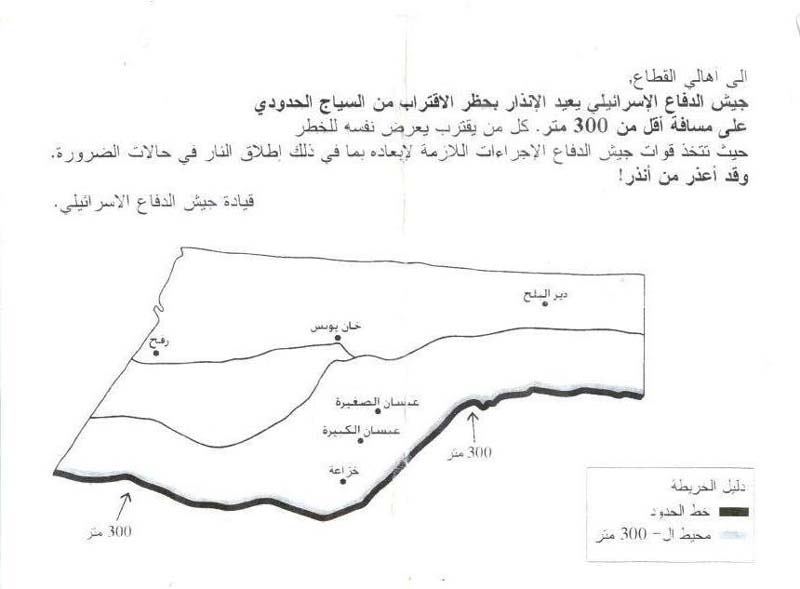
The leaflets, which residents said were dropped in northern and southern Gaza, warned Palestinians not to approach within 300 meters of the Israeli border, and also warned against digging smuggling tunnels into Egypt.

One flier says that the “prohibited zone” includes border areas in Beit Lahiya, Beit Hanoun, and Jabaliya in the north, Khan Younis, Khuza’a, and Abasan in the center, and Rafah in the south.

A second leaflet warns Palestinians against using smuggling tunnels to circumvent the Israeli blockade of the territory.

“Terrorists, tunnel owners, and the smugglers of military equipment know for certain that the continuation of terrorist attacks, the smuggling of military equipment, and the digging of tunnels will be targeted by the IDF, but they continue to work in your residential areas and seek refuge among you," the flier read in Arabic.

“The digging tunnels under your houses and the smuggling of military equipment into Gaza constitutes a threat to your lives, the lives of your children and family, and your property,” it added.

“Do not stay idle and let the terrorists use you. They will not stand beside you when when harm is done to you and your property."

“Take responsibility for your future,” it concludes.

The leaflet also lists an email address and a phone number urging Palestinians to provide information about smugglers and tunnel operators.

A military spokesman confirmed that the leaflets were dropped from air force planes, warning that anyone who comes withing 300 meters of the border is "putting themselves at risk," and also warning against weapons smuggling. The spokesman said "the IDF will operate against anyone who harbors terrorists."

Gaza Crossings Closed

Following the first wave of mortar launches, Israel announced that the Kerem Shalom crossing point was closed when sources said a mortar shells fired from Gaza landed in the area. Palestinian officials said between 86 and 96 trucks had been scheduled deliver aid to Gaza.

Israel shut down its borders with Gaza after the elected Hamas government took full control of the territory in June 2007. The closure has reduced imports of vital goods to one-fifth of pre-blockade levels and prevented the Strip’s 1.5 million residents from leaving.

Tension in the south

On Thursday afternoon an Egyptian soldier was shot dead and two Palestinians wounded during clashes along the border. Demonstrators pelted Egyptian soldiers with stones after a protest rally decrying violence a British-led aid convoy.

The convoy led by British MP George Galloway, entered Gaza on Thursday night, a day after Egyptian riot police injured 50 of its members following a dispute over the group’s route into Gaza.

IOF Drops Warning Leaflets on Gaza Strip Districts

7-1-2010
At app. 9:20am on Thursday 7 January 2010, Israeli airplanes dropped warning leaflets on different areas in Gaza Strip. The leaflets contained warnings to the population. One leaflet threatens people that the IOF would fire at them if they approach as close as 300 meters from border fence. The leaflet contains a rough map of the eastern and northern borders, with marks of what IOF declare as a security 'buffer zone'. This reflects an escalation in Israel's attempts to enforce this security zone inside the Gaza Strip. Al Mezan's documentation indicates that IOF opened fire frequently at Palestinians near the eastern and northern borders. IOF's attacks do not follow a specific pattern. While some attacks have occurred close to the border fence, many other attacks occurred when civilians were more than a kilometer from the the fence.
The second leaflet was directed to the population at large. It contained a statement that what it called 'terrorists, tunnel owners and weapon smugglers' knew that they are legitimate target for the Israeli army; however, continue to work from among civilians and endanger their lives, families and properties. This vague warning raises concerns that IOF would increase disproportionate attacks that fail to distinguish between civilians and combatants in Gaza in violation of international law.

Thursday, September 17, 2009

East Khouzaa destruction & buffer zone

ISM Gaza Strip video

Interview with Dr. Qudeh from the "Brillant Tomorrow For Homes Sons Society" about the destruction of East Khouzaa during the December 2008 - January 2009 Israeli onslaught on Gaza and the attempt of the Israeli occupation forces to establish a "buffer zone" by shooting live ammunition against farmers.


Tuesday, September 15, 2009

Israel targeting fishermen, farmers in Gaza

Eva Bartlett, The Electronic Intifada, 11 September 2009

Masoud Tanboura at Kamal Adwan hospital. (Eva Bartlett)

On 31 August, Israeli gunboats shot at and shelled the fishing trawler of Khaled al-Habil, destroying it completely and leaving the boat's 18 fishermen and their families without a source of income.

One week earlier, on 24 August, Israeli soldiers along Gaza's northern border shot dead a young farm worker, Said al-Hussumi. Sixteen-year-old al-Hussumi was killed while working on land a few hundred meters from the border with his cousin Masoud Tanboura, who was seriously wounded.

"We were working in Attatra, near the sea, about 350 meters from the [border] fence," said Tanboura of Beit Lahiya.

Tanboura's survival is miraculous as his chest cavity was pierced from left to right by a bullet. After seeing his cousin fall dead upon being shot in the chest, Tanboura ran and walked what he estimates was a kilometer, bleeding heavily from his chest, until he came across farmers with a donkey cart. He was transported by donkey cart until a car was able to take him to the Kamal Adwan hospital.

Israeli military sources told reporters two "suspicious" persons had approached the border with Israel and ignored warning shots.

"There was no warning," Tanboura said from his hospital bed. "The Israelis started shooting as soon as we got to the land."

Farm laborers working for 20 to 30 shekels ($5-$6) a day, the two youths had been scouring for pieces of metal to use to fence off the plot of land. They had gotten closer to the border, but this was normal.

"We went there all the time," said Tanboura. "The Israeli soldiers always saw us, they knew we were just taking metal. Many people go there to take metal from destroyed houses," he said.

According to Tanboura, his cousin's dead body was dragged across the ground by Israeli soldiers who took the corpse to Israel and returned it hours later via the Erez crossing.

Tanboura, like some of his brothers, used the meager salary from day labor on farms to support the 15 other siblings in his family.

Killed while collecting figs

On 4 September, 14-year-old Ghazi al-Zaneen from Beit Hanoun was killed when an Israeli soldier shot him in the head. Along with his father, uncles and some of his siblings, the youth had gone to collect figs on their land east of Beit Hanoun. Although it is near the border with Israel, the farmland where al-Zaneen was killed is still more than 500 meters away.

"They had driven to the land and were walking in the area. Ghazi got up on the rubble of a house to look further. Then the Israelis started shooting heavily. Everyone lay on the ground. When the shooting stopped, they got up to run away and realized that Ghazi had been shot in the head," said his aunt.

Maher al-Zaneen, Ghazi's father, testified to the Palestinian Centre for Human Rights that Israeli soldiers continued to fire as he carried the injured boy to the car. Ghazi al-Zaneen succumbed to his critical head injuries the following day.

The day after his death, Ghazi's mother sat surrounded by female relatives and friends. She asked, "How would mothers in your country feel if their sons were killed like this? Don't your politicians care that Israel is killing our children?"

Israeli authorities reportedly claimed that "suspicious Palestinians approached the fence" and troops responded by "firing into the air." But the shot to Ghazi al-Zaneen's head and the two bullet holes in Maher al-Zaneen's car suggest otherwise.

Since the end of Israel's three-week winter invasion of Gaza during which approximately 1,500 Palestinians were killed, nine more Palestinian civilians have been killed at sea or on the strip's border regions. This includes four minors and one mentally disabled adult. Another 30 Palestinians, including eight minors, have been wounded by Israeli shooting and shelling, including by the use of "flechette" dart-bombs on civilian areas.

According to the Food and Agricultural Organization, roughly one third of Gaza's agricultural land lies within the Israel's unilaterally-imposed "no go zone," or "buffer zone." This band of land stretching south to north along Gaza's borders to Israel was established in late 2000 during the second Palestinian intifada. Initially set at 150 meters, it has varied over time. At one point, it was nearly two kilometers in the north and one kilometer in the east. At present, Israeli authorities say 300 meters along the border are "off limits" and those found within the area risk being shot at by Israeli soldiers.

However, one case demonstrates that Israeli soldiers will shoot at Palestinian civilians as far away from the border as 1,800 meters. Sixty-three-year-old Fawzi Ali Qassem was on his land east of Beit Hanoun, at least 1,800 meters away from the border, when Israeli soldiers opened fire on farmers. Ali Qassem was hit in his left thigh on 23 August 2009.

Under a brutal 27-month-long siege, the Israeli military is killing fishermen, farmers and other civilians in areas it is deliberately trying to depopulate. This represents yet another component in Israel's matrix of control over the lives of Palestinians in Gaza. In the face of such blatant Israeli military terrorizing, Palestinians remain defiantly resilient, farming, fishing and living under fire.

Eva Bartlett is a Canadian human rights advocate and freelancer who arrived in Gaza in November 2008 on the third Free Gaza Movement boat. She has been volunteering with the International Solidarity Movement and documenting Israel's ongoing attacks on Palestinians in Gaza. During Israel's recent assault on Gaza, she and other ISM volunteers accompanied ambulances and documenting the Israeli attacks on the Gaza Strip.

Sunday, August 30, 2009

At least 4 Palestinians killed by Israeli forces in the Gaza Strip

Palestinian Centre for Human Rights (PCHR)
25 August 2009
The Palestinian Centre for Human Rights (PCHR) strongly condemns attacks perpetrated by Israeli forces in the evening of 24 August, and the morning of 25 August 2009. Three Palestinians were killed while a fourth is missing consequent to Israeli gunfire in the northern Gaza Strip and aerial bombardment along the Egyptian border, south of Rafah. .
According to investigations conducted by PCHR, at approximately 15:15 on Monday, 24 August 2009, Israeli troops positioned to the northwest of Beit Lahia town in the northern Gaza Strip (along the border between the Gaza Strip and Israel) fired at two Palestinian civilians from Beit Lahia who got close to the border. Sa’id ‘Ata al-Hussumi, 16, was instantly killed by two bullets to the chest, and Mas’oud Mohammed Tanboura, 19, was seriously wounded by several bullets to the chest.
Al-Husumi and Tanboura were working in a farm in Beit Lahia town, approximately 350 meters away from the border fence. They attempted to get close to the border to find metal wires to sell them. They were unarmed.
Israel has illegally prohibited movement near the border fence in the north and in the east of the Gaza Strip. The prohibition applies to within a distance of 300 meters from the border fence inside the Gaza Strip. Accordingly, Palestinian farmers are denied access to their lands. Thus, they are denied their right to cultivate these lands or even to approach them. In many cases, Palestinians come under Israeli gunfire from distances that exceed 300 meters. PCHR has documented many deaths, including children, as a result of Israeli forces firing at civilians while in the proximity of these areas.
In the early morning of Tuesday, 25 August 2009, an Israeli warplane fired a missile at a tunnel near the Salah al-Din Gate in the south of Rafah town on the Palestinian-Egyptian border. Two brothers, Mansour ‘Ali al-Batniji, 30, and Na’el ‘Ali al-Batniji , 20, were killed, and their other brother, Ibrahim, 35, is missing. Another 6 Palestinians were also wounded.
PCHR strongly condemns such escalation by Israeli forces, and:
1. Reiterates its condemnation of such crimes which are part of a series of war crimes committed by Israeli forces in the Occupied Palestinian Territory.
2. Calls upon the international community to immediately intervene to stop such crimes, and renews its call for the High Contracting Parties to the Fourth Geneva Convention to fulfill their obligations.
Updated on August 25, 2009

Sunday, June 14, 2009

Gaza farmers brave Israeli bullets

Electronic Intifada

Rami Almeghari writing from the occupied Gaza Strip, Live from Palestine, 8 June 2009

Mustafa al-Buhairi's family are unable to work their land because of Israeli army threats. (Rami Almeghari)

For more than six decades, the al-Buhairi has family lived on and farmed their land near the boundary with Israel, to the east of Maghazi refugee camp in the central Gaza Strip. Last week Israeli warplanes dropped leaflets warning individuals not to set foot in a 300-meter-wide (1,000 foot) strip of land on the Gaza side of the border.

"We have been here for many years planting peppers, watermelon and wheat," said Mustafa al-Buhairi, 38, standing amidst pepper plants near his home. But "after the last Israeli war against this region in January," he said, "we began to see new Israeli restrictions against our area."

In the last month, Israeli warplanes dropped thousands of similar leaflets on borderline communities from Rafah in the south of the Gaza Strip all the way to Beit Hanoun in the north.

"Suddenly, Israeli F-16 fighter jets made a loud noise then dropped a box that exploded in the sky spreading papers all over our farmland," al-Buhairi recalled.

Al-Buhairi voiced his anger over the Israeli measure explaining that his entire family, including his six children and two brothers, have been badly affected because they are unable to safely work their land.

Despite the risk, al-Buhairi said the family has to continue trying to farm the land because their livelihood depends on it "Yet we are working under risk," he said.

"Four days ago I was irrigating some olive trees which are located beyond the designated limit of 300 meters. Three bullets were shot from that military post on the hilltop," al-Buhairi said, indicating the direction. "One went to the left of me, one to the right and the third over my head."

The leaflets are accompanied by Israeli soldiers patrolling the border area with tanks and jeeps and surveilling the area from watchtowers.

The soldiers have shot at al-Buhairi and his family members with increasing frequency despite the fact that the family's house and land are about 700 meters (2,300 feet) from the border.

Al-Buhairi said the soldiers shoot even up to one kilometer from the border which has made it extremely difficult to harvest produce. He asserted that since the leaflets were dropped, production has fallen sharply.

Nevertheless, al-Buhairi and other farmers harvest their wheat, even under fire: "When they open fire we disappear, and when they stop, we come back."

The al-Buhairi family already lost half of its livestock as Israeli tanks shelled the area near the family home during last winter's invasion of Gaza.

"You see that rubble," al-Buhairi said, pointing to the remains of a building. "That used to be our livestock pen with more than 50 sheep. A tank shell destroyed it, killing 25 of them."

Al-Buhairi and his 80-year-old father echoed a similar sentiment: they had nowhere else to go during the Israeli attack. "We have no other choice, either we live here or we die here."

According to international organizations, the amount of damage on the border area in eastern Gaza Strip could not be properly assessed. The United Nations Food and Agriculture Organization (FAO) says that the area is too dangerous due to continued Israeli army actions and indiscriminate fire against such rural areas.

More than a decade ago, when Israeli occupation forces were present inside Gaza, rather than on the perimeter, Israel declared a one-kilometer buffer zone in an attempt to prevent attacks by resistance forces targeting border patrols.

The current 300-meter limit swallows more than 30 percent of Gaza's arable land, according to the FAO.

Rami Almeghari is a journalist and university lecturer based in the Gaza Strip.

Wednesday, June 3, 2009

UN: Israeli buffer zone eats up 30 percent of Gaza's arable land

Gaza City, Gaza – Israel's warning came from the sky, as it often does in the Gaza Strip. But this time warplanes dropped neither bombs nor missiles on the impoverished Palestinian territory, but thousands of tiny leaflets warning Gaza's residents to keep away from the 30-mile-long border they share with Israel.

Stay at least 300 meters (1,000 feet) from the border, the May 25 pamphlets advised Palestinians, or risk being shot by Israeli Defense Forces (IDF).

Once a plush scene of rolling olive, citrus, and pomegranate groves, much of the border region is now just a barren landscape, marked only by the presence of IDF tanks, military watchtowers, and the occasional pop of gunfire.

Farmers and their families have been displaced, too afraid to return to their fields, while international humanitarian organizations are unable to make an assessment of the needs and damages of the area in the aftermath of the assault.

"We haven't been able to visit this area. No organization has," says Mohammed al-Shattali, project manager for the United Nations Food and Agricultural Organization (FAO) in the Gaza Strip.

"The war increased the amount of land destroyed, particularly in the border areas, and the farmers can't replant anything because it's too dangerous," he says. "The Israeli soldiers, they shoot at everything – dogs, sheep. They are very tense."

An Israeli-imposed buffer zone in the already narrow enclave was established more than a decade ago to thwart attacks by Palestinian militants, who use the border areas to launch homemade rockets at Israeli towns or dig tunnels to carry out attacks against IDF troops stationed at the border.

But what was previously just a sliver of fortified land on the strip's northern and eastern perimeters now, in the aftermath of Israel's January offensive in the territory, swallows roughly 30 percent of Gaza's arable farmland, according to the FAO.

It stretches as deep as 1.25 miles inside Gaza's territory in the north and half a mile in the east, despite the 300-meter figure declared on the leaflets, the organization says. Gaza is just 25 miles long and slightly more than six miles wide.

Israel's rationale: prevent terrorism, future wars
The IDF Spokesperson's Unit officially declined to comment on actions taken in the buffer zone, as well as on whether or not warning leaflets had in fact been dropped.

But Shlomo Brom, an IDF veteran and senior research fellow at the Tel Aviv-based Institute for National Security Studies, says Israeli army policy in the buffer zone is perfectly reasonable given the frequency of attacks by Palestinian fighters.

According to IDF statistics, more than 7,000 rockets have been launched at Israel from the Gaza Strip since 2005. In 2006, Palestinian militants who dug a tunnel under the Israeli-Gazan border captured Israeli Cpl. Gilad Shalit, who has yet to be released.

"The buffer zone makes the digging of such tunnels much more complicated and much more difficult," says Brig. Gen. Brom (ret.). "And Israel established the zone mainly because Palestinian armed groups were attacking Israeli patrols with explosive charges on the Israeli side of the border."

Brom says stricter enforcement of the buffer zone in the wake of Israel's military assault is not aimed at making life more difficult for the people of Gaza, but to prevent them from suffering another similar attack in the future.

"The IDF is now more strict in maintaining this buffer zone because one of the reasons the recent military offensive was launched is because we allowed terrorist activities from Gaza to continue," says Brom. "If we are more strict and we don't allow the situation to deteriorate, then we can avoid a repeat of the last war. There is a smaller probability the fighting will escalate in Gaza."

Dwindling supplies of fresh food
Both Israel's January offensive and the newly expanded buffer zone have devastated Gaza's agricultural sector, the FAO says.

Officially aimed at weakening the power of the Islamist movement Hamas, whose charter calls for the destruction of Israel, the three-week military assault destroyed much of the strip's already dilapidated infrastructure, including wide swaths of agricultural land that are now part of the buffer zone.

The World Food Program (WFP) says the inability of Gaza's farmers to cultivate their land in the wake of the assault is depriving the territory's 1.5 million residents of an important source of otherwise scarce fresh food.

Already sparse after a 2-year economic siege, Gaza's local food markets face dwindling supplies of the parsley, spinach, chickpeas, dates, carrots, and pomegranates once grown on plots of land near the border.

Despite the buffer zone's disastrous effects on the local population, Amnesty International's head researcher for Israel and the Occupied Palestinian Territories says Israel's expansion of it is not without merit.

"The movement westward of the danger zone, or Israel's buffer zone if you'd like, didn't just come out of the blue," Donatella Rovera says.

"Israeli actions are linked somewhat to the fact that on the Palestinian side, there are people who go to these areas simply to farm their land and there are people who go and do other things," she says. "And the latter are legitimate targets, because they are combatants."

But Ms. Rovera says Israel's further encroachment on Gaza's land is disproportionate to the threat involved, suggesting unmanned drones as a possible alternative method of surveillance.

'There has to be a way'
Since the operation ended on Jan. 18, 12 Palestinian civilians have been shot – three of them fatally – in areas within 3,000 feet of the border, according to human rights activists and medical officials here.

Nabeel al-Najjar, a farmer from the rural village of Khuzaa, 15 miles southeast of Gaza City, was shot in the hand on Jan. 23 when he returned to the rubble of his home less than a mile from the border.

"I came back to see if I could get a few things from my house, and they shot me," Mr. Najjar said. "How can I continue to live here knowing I am close enough for them to kill me whenever they want?"

In Jaher Al-Deek, a Bedouin farming village south of Gaza City, Omar Suliman has abandoned his decades-old olive grove, located a quarter mile from the Israeli border, for fear of being shot.

"When I was a kid, we used to be able to go to the border," Mr. Suliman says over the crackle of gunfire from a nearby Israeli observation post.

"We would joke with the Israeli soldiers and give them grapes from our field. They would give us chocolate," he says. "Now, they just shoot at us every day."

Without guarantees for their safety, Gaza's farmers are unlikely to return to the buffer zone in high numbers anytime soon, says the FAO's Mr. Shattali.

"The situation is very sensitive, for both sides," he acknowledges. "But there has to be a way people can cultivate their land without being killed."

Monday, June 1, 2009

Harvest challenges

In Gaza

June 1, 2009, 1:40 pm
Filed under: the "buffer zone"

photo story:

DSC05875

Just after 7 am on May 30th, Palestinian farmers in Khoza’a, east of Khan Younis, returned to the land they’d been menaced off of 5 days earlier. “The same day the Israelis dropped papers saying they would shoot at us for being on our land they did shoot at us,” Ahmed, a 22 year old farmer explained. It was around 10:30, he said. “They were shooting so much that the dirt rose in clouds of dust.”

When we arrive on May 30th, the bales of wheat are ready, all neatly and compactly hand-bundled, covering 30 dunums (1 dunum=1000 square metres) of land belonging to Radi Abu Rayder. He has another 140 dunums which he can no longer access because it lies too close to the border, within the Israel-imposed “buffer zone”.

The farmers will take 2 days to clear the bundles from the field.

DSC05887

DSC05892

The farmers today are two 18 year olds, two 22 year olds, and two men in their late 30s/early 40s.

They work steadily, carrying bales of wheat to the waiting tractor trailer. It is piled as high and full as manageable, then trundles off to a storage field hundreds of metres away, further from the Green Line and the potential danger from Israeli soldiers.

DSC05895

*each time the tractor and trailer amble off, Fathi, one of the men, calls out “yalla, rohe! Gulli ‘yarub’!” [Let's go! Say 'my God' (help us)]

DSC05876

While most of the 30 dunums has been harvested, a small section remains. As some of the farmers off-load the trailer, the others resume hand-picking the wheat, ripping in bunches and laying for bundling.

DSC05898

As they work, they tell us of how the land used to be. “This area used to be so filled with trees you couldn’t see the fence,” Ahmed recalled, gesturing at the naked fields around us. He spoke of how they adapted to the razing of trees and grew, instead, many types of vegetables. “We grew tomatoes, peppers, eggplants, and beans, among other things. We used to fill 17-20 trucks (4 tons each) of produce each day,” he said.

Amazingly, as he recounts their losses, he speaks without audibe bitterness or anger. This is something I’ve come across countless times, whether speaking of razed farmland or a bombed house. The tone, when emotion is evident, is fatigue and confusion: why do they attack us? how are we supposed to live? how can I feed my children?

But Ahmed recounts with a soft smile, just telling how it used to be.

DSC05900

Some time later, we notice thick smoke rising from the direction of the tractor. Moving to see what’s happened, we arrive to find blackened, burnt wheat spread along the dirt track, laid there as the panicked farmers put out the fire. Upon inspection, they see that the tractor crossed under a low-hanging electrical wire which immediately set the dry wheat alight. It’s not hard to imagine how the wheat and barley in Johr ad Dik blazed just weeks ago, after Israeli soldiers shot incendiary bombs into farmers’ fields.

DSC05910

DSC05913

DSC05911

Fathi takes it in stride, accustomed to the struggles of farming in Palestine, though the main obstacles are the siege and the Israeli soldiers’ attacks.

DSC05915

*one of the young farm workers

DSC05931

*the tractor driver and his son.

DSC05930

After two days, the group has successfully brought all of the bales to safety. We are pleased their harvest hasn’t been lost, but not disillusioned to think that this is a victory. Their situation remains the same: each time they go onto their land near the Green Line border fence they face the danger of being targeted by Israeli soldiers from jeeps or from their watchtowers.

A heavy price to pay for working on your land.

Six days earlier, on May 24th, we joined 7 farmers, including women and 1 youth, in a different area of Khoza’a, on land of Nasser abu Rjla a few hundred metres from the border fence. They, too, were harvesting the wheat they had already bundled, though they were forced to bring it in without the luxury of a tractor.

At around 7:45 am the shooting began, coming from one of the mechanical watchtowers this time. These towers are a recent addition to the military landscape: remotely-operated by soldiers, the towers guns can shoot as dangerously close as the guns of Israeli soldiers at the jeeps.

DSC05814

Fifteen year old Mohammed led one of the donkeys hired to haul out the wheat. The tractor driver who’d originally come to take the wheat sprinted off after the heavy shooting, preferring to save himself and his tractor rather than make some shekels.

But others, like Mohammed, are desperate for the work and will take the risk. ‘Take the risk’… how absurd… in any other situation, steering a donkey onto farmland wouldn’t be considered ‘risky’.

DSC05809

Two young boys (not working with our farmers) led donkeys onto the farmland, also needing to take the risk in order to survive.

DSC05810

DSC05815

DSC05818

*Slightly south of the rough track, a house skeleton from the bombardment of Gaza.

DSC05825

The track, aside from being dirt with desert scrub, is mangled by the Israeli tanks and bulldozers which occupied the region during Israel’s war on Gaza. The rickety donkey carts met their match with this terrain, slowing to a crawl to pass over the swells and deep ruts, still repeatedly spilled their loads, causing the wary farmers to stop to re-load. Between the challenges of the track and the tiny cart-space, what would have taken two tractor loads and little time took 8 loads and a good 5 hours, back and forth under the blazing sun, always wary that the shooting could renew at any moment.

ruts

DSC05822

DSC05833

DSC05841

DSC05820

Each load was brought to a safer area on the road, and unloaded onto tarps, the carts going out into the fray anew. Eventually, the harvest was brought in, thankfully without further incident.

The amount of time, worry, and effort still staggers, though by now we’ve seen so many incidents of intense shooting from the Israeli prison-keepers that it has become normal. Palestinian farmers farm to survive, and just barely survive to farm.

DSC05819

Wednesday, May 27, 2009

Israeli forces attempts to legitimize pre-meditated murder and land annexation

In Gaza

May 26, 2009, 3:51 pm
Filed under: the "buffer zone"

gaza

gaza1

“Life is hard for Palestinian farmers in the border region near Israel. The IOF shoot at us every day, any time. They shoot at the international volunteers (ISM) also.”

This was Jaber Abu Rjila testifying some of what he has experienced in the last decade on his land less than 500m from the border with Israel.

jaber

Yesterday, the day before Abu Rjila was interviewed, Israeli occupation forces dropped leaflets along the border area, from north to south, announcing Israel’s unilateral decision that the border area is off-limits and that, by dropping leaflets, Israeli soldiers have the right to shoot to kill anyone found within 300m of the fence. [see translation of the message at the bottom of the page]

Dropping leaflets to try to legitimize Israeli crimes is nothing new: during the 23 day massacre of Gaza, Israeli soldiers dropped leaflets announcing areas which were subject to mass-bombing, saying the residents must leave. Such action does not suddenly render international law insignificant, nor –even if legality were not a question –does it realistically afford the Palestinian civilians in question any option of alternate existence.

During the war, there was no place that people in Gaza felt safe, for good reason, as Israel bombed anything moving and any sanctuary. The leaflets were irrelevant.

As they are here. The farmers and civilians living in the so-called ‘buffer zone’ (Israel-designated; running only along the Palestinian side) have no options to relocate. Gaza, as one may recall, is an incredibly small and densely-populated strip. An incredibly impoverished strip, after the manufactured economical, employment, sanitation, health, nutrition, and education crises, to name just some.

The farmers and civilians living in the 500m to 1 km region along the border have in many cases worked this land for generations. For the majority, this is their only source of income, however meager that may be, particularly since Israel does not allow the export of goods formerly sent to European markets, like strawberries, fruit, carnations, all of which fetched impressive prices.

Those farmers who do not live on the land are working it as their only source of employment, taking home at best $5 a day, when they feel like risking their lives to work.

The Israeli declaration that they will shoot anyone in the border regions is nothing new: Israeli soldiers have been targeting Palestinians and the internationals who accompany them for years. Since the end of the war on Gaza, January 18, alone Israeli soldiers have killed at least 3 people in the border region, including a child, and have injured another 12, including 3 minors and 2 women.

Many of these injuries have occurred at distances greater than 300m, greater even than 500m, from the fence. The injured and killed have been clearly unarmed, visibly no threat to well-armed Israeli soldiers.

In our days accompanying farmers, we have seen Israeli soldiers park their military jeeps and hummers, observe the farmers for lengthy periods, and suddenly begin to shoot dangerously close to the farmers and to us. The soldiers have had ample time to count the number of people present, to watch our activities (the most dangerous aspect of which may be slicing parsley or some poor attempts at Dabke dancing in quieter moments).

Some incidents, recapped, to highlight just how these Israeli army aggressions affect and destroy Palestinians lives:

-Maher Abu-Rajileh (24) from Huza’ah village, east of Khan Younis, was killed by soldiers on January 18 when he returned with his parents and brother to farmland 400m from the Green Line following Israel’s announcement of a ceasefire. At 10 am, after he had spent two hours cleaning up the land from the destruction wreaked by Israeli bulldozers and tanks, Israeli soldiers opened fire, shooting Maher in the chest, killing him instantly.

-On Jan. 20, Israeli soldiers fired on residents of Al-Qarara, near Khan Younis, shooting Waleed Al-Astal (42) in his right foot.

-Soldiers opened fire on Khuza’a village, east of Khan Yunis, on Jan. 23, shooting Nabeel Al-Najjar (40) in the left hand.

-On Jan. 25, Israeli soldiers shot Subhi Qudaih (55) in the back while he was on Khuza’a village farmland.

-On Jan. 27, just outside of Al-Farahin, also east of Khan Younis, soldiers killed Anwar Al-Buraim (26), shooting him in the neck while he picked vegetables on land approximately 500m from the Green Line.

-On February 14th, at approximately 12:00, the body of Hammad Barrak Salem Silmiya, 13, from al-Qerem area east of Jabalia town in the northern Gaza Strip, was brought to Shifa’ Hospital in Gaza City. The child had been shot in the head. According to his family, IOF troops fired at him while he was herding animals in the east of Jabalia town.

-On Feb. 18, farmers returned to harvest land approximately 500 metres from the Green Line where Anwar Al-Buraim was shot dead weeks earlier. As the farm workers were leaving the land, Israeli soldiers targeted Mohammad Al- Buraim, a deaf 20-year-old and cousin of Anwar. Mohammad was with a group of approximately ten farmers pushing their stalled pick-up truck loaded with harvested produce when Israeli soldiers began sniping, hitting Mohammed in the right ankle and continuing to shoot as the farmers, surrounded by international human rights observers, moved away from the field and took shelter behind a nearby house.

-On February 24th, after shooting at farmers and internationals accompanying them in the morning, Israeli soldiers shot a 17 year old girl in the kneecap as she stood near her demolished home roughly 800m from the border. Her knee was completely shattered.

-On March 10th, at approximately 15:30, IOF troops positioned at the border between the Gaza Strip and Israel to the east of al-Maghazi refugee camp in the central Gaza Strip fired at Palestinian houses in the camp. As a result, Muhannad Sehi Abu Mandil, 24, was wounded by a gunshot to the left foot.

-On May 5th, 35-year-old Nafith Abu T’eima sustained light injuries following several gunshot volleys from a passing Israeli militarized jeep, and was hit in the neck with shrapnel. He was tending his lands at the time of the incident and evacuated to hospital.

-On May 7th, 32-year-old Randa Shaloufeh, was working her land near the Israeli-Gaza border when soldiers fired at her. She was shot in her chest and hand.

-On April 10th, a handicapped Palestinian woman, Leila Abu Dagga, was injured when she fell down the stairs from the roof of her house while she was fleeing Israeli soldiers’ gunfire.

And regarding the damage done to land, crops, equipment, and export:

-On May 4th, Israeli troops set fire to Palestinian crops ranging along a 4km stretch along the border. The Palestinian Centre for Human Rights (PCHR) reported that 200,000 square meters of crops were destroyed, including wheat and barley ready for harvest, as well as vegetables, olive and pomegranate trees.

-Ismail Abu Taima explained that over the course of the year he invests about $54,000 in planting, watering and maintenance of the monthly crops. From that investment, if all goes well and crops are harvested throughout the year, he can bring in about $10,000/month, meaning that he can pay off the investment and support the 15 families dependent on the harvest.

Ismail Abu Taima collected valves from the broken irrigation piping. The pipes themselves had been destroyed by a pre-war on Gaza invasion. “The plants have not been watered since one week before the war,” he’d told us. He collected the parts, each valve valuable in a region whose borders are sealed and where replacement parts for everything one could need to replace are unattainable or grossly expensive.

He’d also told us of the chicks in the chicken farm who’d first been dying for want of chicken feed, and then been bulldozed when Israeli soldiers attacked the house and building they were in.

-Abu Alaa lives in Khan Younis and owns land in the newly-extended “Buffer Zone”, the strip of land along the Green Line which, from North to South, cuts into Palestinian land by a full 1 km now.

Israel’s ongoing control of Gaza and its borders has meant that those farmers able to produce vegetables, fruit or flowers cannot export them. For the last 3 years, the flower and strawberry exports have near-completely ceased.

Whereas former years saw over 40 million flowers exported for sale in European markets, Israel finally deigned to allow out a fractional 25,000, much too little, much too late. Last year farmers fed flowers to their animals, in protest and frustration at the closed borders.

-At 2:30 pm January 17, 4 massive Israeli tanks and 1 towering military bulldozer accompanied a smaller military bulldozer and invading, occupying Israeli soldiers as they blazed towards Manwa’s, yelling through a megaphone, ordering them to get out of the house. Sharifa, 22, left first. Soldiers asked her if there were any men inside the house, to which she replied ‘no’. Manwa came next, also with hands in the air. The question was repeated, soldiers not believing the women could stay by themselves, telling the women as much.

It was 3 weeks after Israel’s Gaza-wide air-strikes began, and the fact that Manwa and Sharifa had stuck it out alone in that isolated area is incredible.

“They told me our house was now in a closed military zone,” Manwas said. “They said it was a ‘decision from the top’ and that we had to leave immediately and walk towards Gaza,” she said. “I refused, and tried to negotiate with them for time to gather our belongings. They refused.”

Manwa was a safe distance away, watching, when the Israeli soldiers bulldozed her house at 5 pm that day.

This was one day before Israel declared a ceasefire…

The flat fields around us once held olive, lemon and palm trees, Saber tells us. About 750 dunums (1 dunum=1000 square metres). “People from all over Gaza had jobs here. It is one of the best regions for agriculture in Gaza,” Saber goes on. He doesn’t need to spell out that all of the trees had been bulldozed, like the houses, over the years since 2003. We know, are aware of Israel’s policy of razing Palestinian land.

-accounts of various farmers in the ‘buffer zone’

translation of the flyer:

(on both sides the same writing but different maps)

to the people of the strip:

the israeli defence forces repeat their alert forbidding

the coming close to the border fence at a distance less than 300 metres

who gets close will subject himself to danger whererby the IDF will take necessary procedures to drive him away which will

include shooting when necessary

he who has alerted shall be excused!

-the IDF

DSC04093

*Palestinian home roughly 500m from the border with Israel, bearing the traces of various Israeli soldiers’ shooting incidents.

blood

*blood from Mohammed al Buraim, shot in the ankle by Israeli soldiers on February 18th.

Monday, May 25, 2009

The leaflets thrown by the Israeli aircrafts

translation:
(on both sides the same writing but different maps)
to the people of the strip:
the israeli defence forces repeat their alert forbidding
the coming close to the border fence at a distance less than 300 metres
who gets close will subject himself to danger whererby the IDF will take necessary procedures to drive him away which will
include shooting when necessary
he who has alerted shall be excused!
the IDF


Leaflets dropped on Gaza ordering citizens to stay away from border areas
[ 25/05/2009 - 08:12 PM ]

GAZA, (PIC)-- Israeli helicopters dropped on Monday morning thousands of leaflets ordering the Palestinians to stay away from border areas in the Gaza Strip, and threatening to open fire at any citizen approaching the borderlines.

The leaflets state that the Gaza people should not approach the electronic border fence, and should be at least 300 meters away from the fence or else they would be targeted by Israeli military fire.

Also, the leaflets include maps showing the areas that the Palestinians are not allowed to get near.

Warning leaflets were dropped over Beit Hanoun and Beit Lahia in the north, in addition to Al- Maghazi, Dir Al Balah and Abasan in Khan Younis, as well as all border areas in the Rafah area in the southern part of the Strip.

Many Gazans living near border areas will become homeless because they will have to leave their homes if Israel wages aerial attacks on the specified areas.

Press Release of Beit Hanoun Local Initiative about Israeli threats

Beit Hanoun, Gaza
During the early hours of the morning today, Monday May 25, 2009, the occupation forces dropped by their war planes a container with flyers which include statements that threaten to attack the Palestinians living in Beit Hanoun closest to the 1948 lands. The flyers stated that any civilian who gets 300 metres or less from the borders they will be shot. Previously, on the 27th of December 2008, the IOF had stated it will attack any civilian that is 1 km or less from the border.

The Beit Hanoun Local Initiative coordinator, Saber al Zaaneen, stated that this was an unjust unilateral decision by the occupation forces which directly affects the livelihoods of hundreds of Palestinians that work on their land, dependent on harvesting and plantation.
Zaaneen also stated that the occupation forces had directly shot at a group of volunteers near the borders on July 1, 2008, who had arranged for weekly demonstrations to occur. Despite the IOF targeting them, the volunteers persisted their way.
After the latest genocidal attacks against the Palestinian people, the IOF disallowed civilians, farmers and volunteers, from being 1 km or less from the borders, as well as destroying all homes, plantations and farmlands present within that distance.
Today's IOF decision of attacking anyone within 300 m from the borders is a farce, as they had already been doing so from the start, as well as disallowing farmers from getting to their lands. This is just another way that the occupation forces exercise their neo-colonialist tactics and operations.
The Beit Hanoun Local Initiative urges all people of good conscience to stand by the Palestinian people in those harsh cicumstances, in acts of solidairty and thereby enabling the volunteers to continue their work and support them as such.

Israeli planes drop warning pamphlets over Gaza

Ha’aretz

25 May 2009

Israel Air Force aircraft have scattered pamphlets over the Gaza Strip warning residents to stay away from the border, The Associated Press reported Monday.

The heavily guarded border is the scene of sporadic fighting between militants and Israel Defense Forces troops. Israeli forces killed two Palestinian gunmen in a clash on Friday.

The Arabic pamphlets warned Gazans to stay out of areas 300 meters to 500 meters from the border fence, saying they risk being shot.

The IDF had no comment. The military has scattered similar warning pamphlets in the past.

Gaza’s Health Ministry said a 10-year-old boy was struck by a box of leaflets and moderately hurt during Monday’s airdrop.

Violence has largely subsided in Gaza following Israel’s 3-week offensive against the coastal territory’s Hamas rulers in January

Israel warns Palestinians to stay away from Gaza border wall
Date: 25 / 05 / 2009 Time: 11:48

[Ma'anImages]
Bethlehem - Ma'an - Israel's air force used helicopters to drop fliers warning Palestinians to stay away from the Gaza border wall on Monday, residents.

"You have been warned. We urge residents of the Strip to keep a 300 meter distance from the fence," the fliers read.

Commenting on the message, a Gazan citizen told Ma’an, “Israel is seeking a new immigration of the Palestinians especially that the warning is not to passersby, but to residents living near the borderline. There are homes which are less than tens of meters away from the borderline, and there are agricultural lands close to the border fence.”

Twelve-year-old Muhammad Dughmush from the Tel Al-Hawa neighborhood of Gaza City was injured by a box of fliers dropped by Israeli choppers. According to Muawiya Hassanein, director of Ambulance and Emergency Services at the Palestinian Health Ministry, the boy received first aid at the Jordanian hospital before he was transferred to Ash-Shifa Hospital in Gaza City, suffering bruises along his back.

The fliers were dropped over the homes of residents in Beit Hanoun and Beit Lahiya in northern Gaza, Ynet said, as well near communities in the south and central regions near Khan Younis, Kerem Shalom and Rafah.

In a statement, the Israeli military confirmed that it dropped the leaflets, warning that it "will operate against all those who approach the fence, due to the threat that they pose to the civilians of the State of Israel."

Israeli leaflets warn Gazans to keep away from border


Gaza, May 25, 2009 (Ramattan) – Israeli aircraft on early Monday dropped flyers over the Palestinian Gaza Strip, warning the residents there to stay away from the security fence that separates between the Jewish state and the Hamas-controlled Strip.

The leaflets spread over the skies of northern Gaza Strip and eastern Gaza city, as well as in southern Gaza Strip towns of Khan Younis and Rafah.

"It is forbidden for anyone to go beyond a distance of 300 meters from the fence and the Israeli defense forces will take necessary measures to turn him away, including shooting when it is necessary," one of the leaflets read.

An initial map was drawn in black and grey on a white paper that showed the border fence and the buffer zone which stretched between the two ends of the Gaza Strip.

Israel used to keep no-go areas along its borders with the Gaza Strip since the beginning of the Palestinian uprising in 2000. However, the space of the buffer zones used to change according to the security situation.

The last time Israel dropped aerial warnings on Gaza was during the major three-week military offensive between December 2008 and January 2009.

Israel and the Islamic Hamas movement are not observing a ceasefire these days but each side maintains a level of relative quietness.