Wednesday, September 23, 2009

Israeli massacre and siege overshadow all:Eid day 2

In Gaza

DSC08846
“I had a chicken farm with 3,000 chickens. On the 300 dunams [1 dunam is 1000 square metres] of land I share with neighbours I had 300 olive trees, 130 dates, 200 lemons, 150 papayas, 500 guavas, 200 clementines. I had 50 dunams of wheat and another 50 of peas.

This was all destroyed, all but about 400 chickens. Destroyed before Israel even waged it’s 23 day massacre of Gaza in winter 2008/2009. The last of the chickens died in that attack.

My radish crops, which I’d planted where trees once stood, I had to plow under because they were poisoned by the phosphorous which rained down here.”
Down in Al Faraheen, the farming village east of Khan Younis, a visiting delegation wants to see life in the ‘buffer zone‘. We visit Jaber Abu Rjila whose daily life is a microcosm of many of the problems in Gaza:
-his land has been razed repeatedly by invading Israeli bulldozers;
-his house has been shot up by the Israeli soldiers powering the military dozers; his wife and children have been terrorized, trapped in their home while the invaders shot up and destroyed their livelihoods –one of his younger daughters is psychologically scarred from the experience, won’t eat, is consequently malnourished and nervous;
-their agricultural practices have been devastated by the Israeli massacre in winter 2008/2009, by prior Israeli invasions, by the all-encompassing Israeli-led but internationally-complicit siege on Gaza;
-their farmland, aside from being rendered off-limits by the Israeli-imposed ‘buffer zone’, has been poisoned by the chemical munitions rained upon them during the winter Israeli massacre;
-he has lost relatives and friends to the bullets of Israeli soldiers invading his community…
Their list is a long one, and Jaber is vocal.
We re-visit the May 1st, 2008 Israeli invasion which was the most catastrophic to their livelihood: in a day, their chicken farm, orchards of mature olive and fruit trees, and farm equipment were all destroyed by the Israeli bulldozers, tanks, and soldiers who overtook the region.
We re-visit the winter massacre, during which Faraheen residents evacuated their homes and returned to destruction. Jaber still has what he says is a white phosphorous shell. And has, with his dry sense of humour, fashioned a wind-chime out of spent Israeli ammunition casings.
DSC08848
DSC08844
DSC08849
We ask: how do you know the Israeli army fired chemicals on your land. He cites the crops he’s had to plow under for their poor growth; he points out a date tree that isn’t producing like it should [there are a few bunches of dates where there should be tens, he says].
As we leave, trying to keep to the delegation’s schedule, Jaber and Leila are non-surprisingly insistent we stay: for a meal, for the night… it is only 11 am.
In Khoza’a, another farming village a little further south along the border, we meet Iman An Najjar, one of the hundreds of residents subject to Israeli military terror during the massacre. Khoza’a became internationally known for the multiple atrocities which occurred by the invading Israeli soldiers: civilians were bombed in their homes, were shot while holding white flags, had to flee the Israeli bulldozers leveling home after home, and were subject to clouds of white phosphorous which burned to the bone, killing and scarring for life. The most intense period lasted from early morning to evening 13 January, after which a reported 14 Khoza’a residents were slain, 50 injured, and over 200 suffered gas inhalation. [see: Chaos in Khoza'a ]
DSC08851
*Iman an Najjar relates the horrors of the 13 January massacre.
DSC08854
DSC08856
DSC08858
DSC08860
*boys from Khoza’a.
In Gaza, many feel that Eid, a time of joy for Muslims, is only really for children, as they can be temporarily distracted and made happy by the toys and holiday joy. But for many children, balloons and new clothes won’t even dent the psychological damage and trauma of their experience during the Israeli massacre.
Back in Gaza City in the early evening, the streets are now packed with shebab –the young men of Palestine. They tour arm in arm or in small groups, friends united, roaming and looking for something to do. They are joined by families, likewise streaming down the main street in Rimal area, many heading for the one park in the area, to sit, drink tea, and watch for friends. People are dressed in their best, many in new clothes, and walk proudly.
But that’s it, that’s all there is for them. Nothing special to enjoy, no means of celebrating with family or friends in the occupied West Bank, no means of holiday travel like people elsewhere in the world.

Monday, September 21, 2009

Popular resistance lives on in Gaza

Eva Bartlett | In Gaza
19 September 2009
Palestinian farmers protest the siege in Gaza
On 15 September, we join farmers and residents, including a contingent of women, youths and men, in a non-violent walk to the border region east of Beit Hanoun in the north of Gaza, singing and chanting as they march past Israeli army razed fields and destroyed water tanks and cisterns. The march is in the tradition of popular resistance in Palestine, more widely known worldwide in the villages of Bil’in and Ni’lin, but equally practised all over occupied Palestine, including Gaza, in the simplest of acts: farming and accessing land which the Israeli authorities’ policies continue to attempt to render barren and void of Palestinian life.
[In the two well-known occupied West Bank regions, Bil'in and Ni'lin, the Israeli occupation army has ramped things up to such a violent suppression of non-violent voices that the April 17th killing of Bil'in villager, Basem Abu Rahme (29, strong, gentle, slain by an Israeli-soldier-shot, high-velocity tear gas canister to the chest from a close distance) , was the 18th murder of non-violent protesters against the separation Wall (11 of these murdered were under 18 years; 7 were 15 years old or under).]
The Beit Hanoun protesters’ message: for Israeli soldiers to stop targeting farmers, for Israeli authorities to end the (intentional) practice of driving Palestinian farmers off of their land. They call also for access to water, highlighting that in that region all but a single water source have been destroyed. This tank serves 40 dunams (1 dunam is 1,000 square metres) of farmland.
What has led these citizens to take up flags and placards? An on-going series of Israeli army targeted-shootings, tank and bulldozer invasions, destruction of farmland, and kidnapping of Palestinian civilians, rendering even the simple act of tending trees on farmland impossible or highly dangerous, risking injury or death from Israeli gunfire.
An exaggeration?
Since the end of Israel’s 23 day winter massacre of Gaza, another eight Palestinian civilians have been killed in the Strip’s border regions, including four minors (3 boys and 1 girl) and one mentally disabled adult. Another 28 Palestinians, including eight minors (7 boys, 1 girl) and 2 women, have been injured by Israeli shooting and shelling, including by the use of ‘flechette’ dart-bombs on civilian areas.
It’s an apt name and a struggle that goes back months, years, but gets almost no recognition in the international corporate media. Neither civilian deaths while farming, nor the steady non-violent resistance to Israeli land annexation seem to be sensational enough.
But while these Beit Hanoun civilians are unarmed, they are not naïve, not passive.
“Buhrrrah, wa dam, nafdiq ya Falasteen: Our soul and blood, we sacrifice for you Palestine,” they chant.
They tell us their first choice is to live and farm peacefully in their region near the border to Israel. But if it comes to it, they will die on their land, for their land, for their families, while farming.
They have little-to-no choice.
With Gaza’s borders firmly sealed shut under the internationally-complicit, Israeli-led and Egyptian-backed siege on Gaza, there is no option for emigration, no option for work in Israel or Egypt, no option to start up new businesses importing goods…
When considering these civilians and farmers, it is imperative to recognize that 95% of Gaza’s industry has been shut down by Israeli attacks and the siege. That roughly one third of Gaza’s farmland has been swallowed by a no-go, Israeli-imposed ‘buffer zone’ in which Israeli soldiers reserve the right to shoot-to-kill.
Roughly a decade ago, Israeli authorities unilaterally established an off-limits ‘buffer zone’ on the 150 metres of land extending along the Green Line border between Gaza and Israel. Since inception, the ‘buffer zone’ has swollen to over 1 km in the east and 2 km in the north (during and immediately after Israel’s 23 day massacre of Gaza in winter 2008/2009), to the present 300 metre off-limits area (heralded in May 2009 by the dropping of leaflets which stated:
“The Israeli Defence Forces repeat their alert forbidding the coming close to the border fence at a distance less than 300 metres. Who gets close will subject himself to danger whererby the IDF will take necessary procedures to drive him away which will include shooting when necessary.”
The ‘buffer zone’ swallows prime, fertile agricultural land, cutting off another means of self-sustenance in a Strip that has been under siege since after Hamas’ election in 2006.
International bodies, including the Food and Agricultural Organization (FAO), the World Food Program (WFP), and the World Health Organization (WHO) note that between 35% to 60% of Gaza’s agricultural industry has been destroyed and rendered useless [from the winter Israeli massacre of Gaza and from various Israeli invasions, attacks, burning of crops, and the impact of the siege].
Whereas formerly Gaza production met half the Strip’s agricultural needs, the effects of attacks and siege on Gaza has devolved the agricultural sector to what the Gaza-based Agricultural Development Association of Gaza aptly cited as a “destruction of all means of life.”
We pass farmers on a donkey cart loaded with plastic jugs filled with water. They ask how they are supposed to water, let alone reach, the paltry few trees on their land near the ‘buffer zone’.
We continue walking, getting a close look at the heaps of rubble which were water tanks and wells. The march reaches a larger well, it’s covering now at a wounded 45 degree slant, the sweet water within off-limits to farmers and their trees.
While speeches are made, pledging to continue to farm, continue to non-violently resist this flagrant Israeli bullying and land-grab policy, some of the weathered farmers in the area approach, keen to share their miseries to those who would listen.
Salem As Saed is 59, has 4.5 dunams of land which once held orange and olive trees until occupational bulldozers ground them to the earth. He has 17 children who he is unable to support; they are all dependent on food-aid handouts.
Awad, (55) has 17 in family and no means of income. His land has been razed, water sources destroyed. Of the 93 dunams of trees he once had, the vast majority have been destroyed. Awad has planted new trees, but these are scant in number and failing from want of water.
He has a further 30 dunams closer to the border, which he cannot access, has not accessed in years. Two years ago, Awad was shot by Israeli soldiers in the area of the Israeli watch tower at the border. He says that he was working with his son some 500 metres from the fence when the Israeli soldiers began shooting without warning. He was hit by a bullet to his inner thigh; his son was abducted and imprisoned for 28 days.
The speeches end and demonstrators kneel, beginning to pray on their land.
The demonstration ends without incident, though the daily dangers remain once the cameras are gone.
As we walk back towards Beit Hanoun, we discuss some those recently assassinated and injured in the buffer zones at the hands of Israeli soldiers.
On the morning of 9 September, and also in the Beit Hanoun border region, Maysara al Kafarna, a 24 year old from Beit Hanoun, was shot in the foot by Israeli soldiers at the Green Line border between Gaza and Israel. The Palestinian Centre for Human Rights (PCHR) notes that the youth was 350 metres from the border fence when targeted.
PCHR reports that a few hours later, at 10 am, Israeli soldiers invaded as deeply as 700 metres into areas north of Beit Hanoun, firing at homes and farmland.
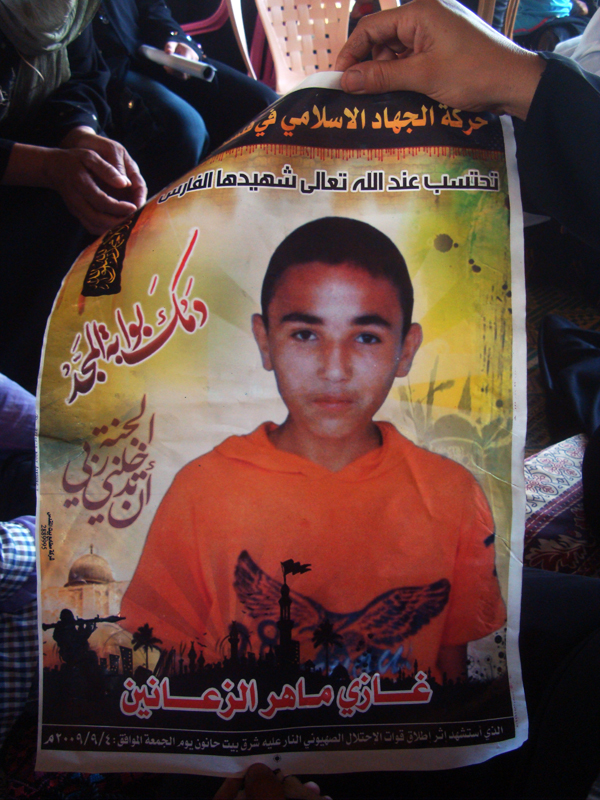
Five days prior, Israeli soldiers shot dead a 14 year old boy, targeting him with a bullet to the head. PCHR reports that in the afternoon of 4 September Ghazi Al Zaneen and family were walking in the northeastern Beit Hanoun region to agricultural land they owned 500 metres from the border when –with no warning messages or warning shots –Israeli soldiers opened sustained fire at the family, the last bullets hitting the boy and the family car as the father evacuated his son. Critically injured, Ghazi died the following day.
On 2 September, according to PCHR, when Israeli occupation forces invaded 150 metres into northern Beit Hanoun, Palestinian resistance confronted the invasion, defending themselves against the occupiers’ invasion. In the firing that ensued, a 17 year old, ‘Abdul ‘Aziz al-Masri, living in the region was shot in the foot. Not farming, the youth was subject to danger due to the Israeli invasion.
A week prior to that, on 23 August, PCHR reports Israeli soldiers opened fire on areas to the east of Beit Hanoun, shooting 63 year old Fawzi Ali Wassem in the thigh. The farmer was on agricultural land 1,800 metres from the border.
The morbid list of ‘buffer zone’ fatalities and injuries continues in Beit Hanoun regions (and throughout the Gaza Strip):
-Saleh Mohammed al-Zummara, 66, injured by a gunshot to the left hand and ‘Ali Mohammed al-Zummara, 65, injured by shrapnel in the back from Israeli soldiers’ firing on 3 June, according to PCHR.
- Ziad Salem abu Hadayid, 23, is shot in the legs when Israeli soldiers shoot on Palestinian farmers on 20 May, according to the Al Mezan centre for Human Rights.
-We find Ahmed Abu Hashish’s decomposed body, missing since 21 April, is found shot dead, presumably by Israeli soldiers, in the eastern Beit Hanoun border region on 14 June. As we and Local Initiative volunteers search for then remove the body, we come under close and intense fire from the Israeli soldiers at the border. We are clearly, visibly unarmed; the shooting intesifies when the soldiers see that we have located the body. It is pure spite.
And this is without mentioning the equally brutal assaults on other regions along the ‘buffer zone’. Nor Israeli soldiers’ intentional arson of Palestinian crops. Nor mentioning the abductions of civilians –the latest, 5 minors from Beit Lahiya’s bedouin village region. Abducted on 6 September as they herded their sheep and goats, they are:
1. Mohammed ‘Arafat Abu Khousa, 17;
2. Sameh ‘Abdul Qader Abu Hashish, 15;
3. Fraih Qassem Abu Hashish, 12;
4. ‘Aa’ed Hazzaa’ Abu Hashish, 16; and
5. Ibrahim Shihda Abu Jarad, 17.
Look carefully at the faces in the above photos: these are the civilians facing the world’s fourth most powerful military. These are the people eeking a living or living in a region which has been arbitrarily cut off and assaulted by the state which purports to ‘defend itself’. Look carefully, and hope that they are not among the next to be martyred by Israeli assaults.

Sunday, September 20, 2009

PCHR weekly report 10-16/9/2009: 3 Palestinians arrested one detained inside Gaza Strip


In the Gaza Strip, IOF conducted 3 limited incursions into Palestinian communities, during which they leveled areas of Palestinian land they had already razed.  They also arrested 3 Palestinians


Thursday, 10 September 2009 

At approximately 01:00, IOF moved nearly 300 meters into the east of al-Maghazi refugee camp in the central Gaza Strip.  They leveled areas of land and opened fire indiscriminately.  They withdrew from the area a few hours later and no casualties were reported.  

Friday, 11 September 2009 

In the evening, an IOF infantry unit moved nearly 500 meters into the east of al-Boreij refugee camp in the central Gaza Strip.  At approximately 18:00, they arrested Nahidh Mohammed al-Tawail, 22.  They forced him to walk towards the border between the Gaza Strip and Israel.  They detained him until noon on the following day.   

Monday, 14 September 2009 

At approximately 00:15, an IOF infantry unit moved nearly 800 meters into the east of al-Boreij refugee camp in the central Gaza Strip.  Israeli soldiers searched agricultural lands in the area and arrested 3 Palestinians who have not been identified. 

Thursday, September 17, 2009

East Khouzaa destruction & buffer zone

ISM Gaza Strip video

Interview with Dr. Qudeh from the "Brillant Tomorrow For Homes Sons Society" about the destruction of East Khouzaa during the December 2008 - January 2009 Israeli onslaught on Gaza and the attempt of the Israeli occupation forces to establish a "buffer zone" by shooting live ammunition against farmers.


Wednesday, September 16, 2009

Gaza: Khan Younis building comes under Israeli fire

Published yesterday (updated) 16/09/2009 23:11
 
Bethlehem/Gaza - Ma'an - Israeli forces targeted a building in eastern Khan Younis, launching at least one shell, but caused no damage or injuries.

The attack came after Israeli media sources reported Gazan fighters launched a projectile toward Israeli targets. The report said the projectile landed on the Gazan side of the border fence.

List of Palestinian farmers & other civilians shot in Gaza Strip’s rural communities since the declaration of the ceasefire on the 18th of January 2009


UPDATE 15/9/2009
Several farmers and other Palestinian civilians have been shot by Israeli forces while in rural communities since the 18th of January 2009 when Israel declared a unilateral “ceasefire”. This list includes only confirmed cases of Palestinian civilians killed or injured by gunfire or (shrapnel of) artillery shells. It doesn’t include Palestinian civilians killed or injured by air strikes, previously unexploded Israeli ordinances, or injured while trying to escape from Israeli gunfire. It doesn’t include cases of casualties reported but not confirmed with their names [ 1, 2]
According to this list, 7 Palestinian civilians (among them 3 boys and 1 girl) have been assassinated and 28 others (among them 7 boys, 1 girl, 2 women) have been injured by IOF gunfire or shelling.
In this list we should probably add the case of Ahmed Abu Hashish who went missing on the 21st of April and his dead body was found on the  14th of June by a group  formed by locals (including his father and activists of the Beit Hanoun Local Initiative) and ISM Gaza Strip activists that went under Israeli gunfire too. Ahmed Abu Hashish is believed to have been assassinated by IOF troops.
  1. 15 September 2009, Khan Younis: Fadi Odeh Abu Mu’ammar, 28
  2. 15 September 2009, Khan Younis: Muhammad Odeh Abu Mu’ammar, 26
  3. 9 September 2009, Beit Hanoun: Maysara Mohammed Hussein al-Kafarna, 24, wounded by a gunshot to the right foot.
  4. 4 September 2009, Beit Hanoun: Ghazi al-Za’anin, 14,was wounded by a bullet to the head and died the following morning.
  5. 2 September 2009, Beit Hanoun: 17-year-old 'Abdul 'Aziz al-Masri, was wounded by a gunshot to the right foot.
  6. 24 August 2009, Beit Lahia: Mas’oud Mohammed Tanboura, 19, was seriously wounded by several bullets to the chest
  7. 24 August 2009, Beit Lahia: Sa’id ‘Ata al-Hussumi, 16, was instantly killed by two bullets to the chest
  8. 23 August 2009, Beit Hanoun: Fawzi 'Ali Qassem, 63, was wounded by a gunshot to the left thigh
  9. 22 August 2009, Sheikh Zayed, Beit Lahia: Murad Salman al-Wazir, 17, wounded by a gunshot to the left leg.
  10. 21 July 2009, Abassan: Majed Majdi al-Farra, 20, was wounded by shrapnel to the right hand
  11. 19 July 2009, east of Gaza city: Ahmed Zuhair al-Semari, 22, was hit by a gunshot that entered the abdomen and exited the back. Kidnapped, transferred to Israeli hospital where died.
  12. 15 July 2009, Abassan Jedida – Faraheen: Karem Hamdan Sarem Qudeh, 16, injured by shrapnel, above the eye
  13. 2 July 2009, Juhr Ad Dik: Husam Abu A'yesh, 24, was also injured by shrapnel
  14. 2 July 2009, Juhr Ad Dik: Hiam Abu A'yesh, 17, killed by Israeli shell
  15. 5 June 2009, Shoka, Rafah: Khaled Ismail Mohammed Jahjuh was shot in his lower spine
  16. 3 June 2009, Beit Hanoun: 'Ali Mohammed al-Zummara, 65, injured by shrapnel in the back
  17. 3 June 2009, Beit Hanoun: Saleh Mohammed al-Zummara, 66, injured by a gunshot to the left hand
  18. 3 June 2009, Bedouin village 'Um An-Nassir': Ahmed Tawfiq Abu Hashish, 17, injured by shrapnel to the left shoulder and foot.
  19. 3 June 2009, Bedouin village 'Um An-Nassir': Saleh Ahmed al-Madani, 17, seriously injured by shrapnel to the neck and the left shoulder
  20. 20 May 2009, Beit Hanoun: Ziad Salem abu Hadayid, 23, was shot in his legs with live ammunition by Israeli forces.
  21. 7 May 2009, Rafah: Randa Shaloof, 32, was shot in her hand and chest with live ammunition by Israeli forces.
  22. 3 May 2009, Beit Hanoun: Mohamed Harb Shamia, 12, was injured in his leg and abducted by Israeli forces.
  23. 3 May 2009, East of Jabalya: 30-year-old Mona Selmi As-Sawarka was injured by shrapnel wounds to her chest
  24. 2 May 2009, Khoza'a: Nafith Abu T'eima, 35, injured in his neck by shrapnel from Israeli forces.
  25. 10 March 2009, al-Maghazi refugee camp: Muhannad Sehi Abu Mandil, 24, was shot in the left foot with live ammunition by Israeli forces.
  26. 24 February 2009, Khoza'a: Wafa Al Najar, 17, was shot in the kneecap with live ammuntion by Israeli forces.
  27. 18 February 2009, Al Faraheen: Mohammad al-Ibrim, 20, was shot in the right leg with live ammunition by Israeli forces.
  28. 14 February 2009, Jabaliya: Hammad Barrak Salem Silmiya, 13, was killed when Israeli forces shot him in the head with live ammunition.
  29. 27 January 2009, Al Faraheen: Anwar al Ibrim, 27, was killed when Israeli forces shot him in the neck with live ammunition.
  30. 27 January 2009, east of Deir Al Balah: Mohammed Salama al-Ma'ni, 21, was wounded by a gunshot to the left thigh.
  31. 25 January 2009, Khoza'a: Subhi Tafesh Qudaih, 55, was wounded by a gunshot to the back
  32. 23 January 2009, Khoza'a: Nabeel Ibrahim al-Najjar, 40, was wounded by shrapnel from a gunshot to the left hand by Israeli forces.
  33. 22 January 2009, Sheyjaiee: 7 year old Ahmed Hassanian shot in the head
  34. 20 January 2009, al-Qarara: Israeli soldiers shot Waleed al-Astal, 42, in his right foot.
  35. 18 January 2009, Khoza'a:Maher 'Abdul 'Azim Abu Rjaila, 23, was killed when Israeli forces shot him in the chest with live ammunition.

IOF troops wound two brothers in Gaza


[ 16/09/2009 - 10:31 AM ]


KHAN YOUNIS, (PIC)-- Two Palestinian brothers were wounded east of Khan Younis to the south of the Gaza Strip on Tuesday in the explosion of an Israeli tank shell, Palestinian health ministry said.
It added in a statement that the two brothers Fadi Abu Muamer, 28, and Mohammed Abu Muamer, 26, were wounded with the shell's shrapnel.
Both were rushed to the operations room suffering from wounds all over their bodies, the ministry added.

Tuesday, September 15, 2009

Israel targeting fishermen, farmers in Gaza

Eva Bartlett, The Electronic Intifada, 11 September 2009

Masoud Tanboura at Kamal Adwan hospital. (Eva Bartlett)

On 31 August, Israeli gunboats shot at and shelled the fishing trawler of Khaled al-Habil, destroying it completely and leaving the boat's 18 fishermen and their families without a source of income.

One week earlier, on 24 August, Israeli soldiers along Gaza's northern border shot dead a young farm worker, Said al-Hussumi. Sixteen-year-old al-Hussumi was killed while working on land a few hundred meters from the border with his cousin Masoud Tanboura, who was seriously wounded.

"We were working in Attatra, near the sea, about 350 meters from the [border] fence," said Tanboura of Beit Lahiya.

Tanboura's survival is miraculous as his chest cavity was pierced from left to right by a bullet. After seeing his cousin fall dead upon being shot in the chest, Tanboura ran and walked what he estimates was a kilometer, bleeding heavily from his chest, until he came across farmers with a donkey cart. He was transported by donkey cart until a car was able to take him to the Kamal Adwan hospital.

Israeli military sources told reporters two "suspicious" persons had approached the border with Israel and ignored warning shots.

"There was no warning," Tanboura said from his hospital bed. "The Israelis started shooting as soon as we got to the land."

Farm laborers working for 20 to 30 shekels ($5-$6) a day, the two youths had been scouring for pieces of metal to use to fence off the plot of land. They had gotten closer to the border, but this was normal.

"We went there all the time," said Tanboura. "The Israeli soldiers always saw us, they knew we were just taking metal. Many people go there to take metal from destroyed houses," he said.

According to Tanboura, his cousin's dead body was dragged across the ground by Israeli soldiers who took the corpse to Israel and returned it hours later via the Erez crossing.

Tanboura, like some of his brothers, used the meager salary from day labor on farms to support the 15 other siblings in his family.

Killed while collecting figs

On 4 September, 14-year-old Ghazi al-Zaneen from Beit Hanoun was killed when an Israeli soldier shot him in the head. Along with his father, uncles and some of his siblings, the youth had gone to collect figs on their land east of Beit Hanoun. Although it is near the border with Israel, the farmland where al-Zaneen was killed is still more than 500 meters away.

"They had driven to the land and were walking in the area. Ghazi got up on the rubble of a house to look further. Then the Israelis started shooting heavily. Everyone lay on the ground. When the shooting stopped, they got up to run away and realized that Ghazi had been shot in the head," said his aunt.

Maher al-Zaneen, Ghazi's father, testified to the Palestinian Centre for Human Rights that Israeli soldiers continued to fire as he carried the injured boy to the car. Ghazi al-Zaneen succumbed to his critical head injuries the following day.

The day after his death, Ghazi's mother sat surrounded by female relatives and friends. She asked, "How would mothers in your country feel if their sons were killed like this? Don't your politicians care that Israel is killing our children?"

Israeli authorities reportedly claimed that "suspicious Palestinians approached the fence" and troops responded by "firing into the air." But the shot to Ghazi al-Zaneen's head and the two bullet holes in Maher al-Zaneen's car suggest otherwise.

Since the end of Israel's three-week winter invasion of Gaza during which approximately 1,500 Palestinians were killed, nine more Palestinian civilians have been killed at sea or on the strip's border regions. This includes four minors and one mentally disabled adult. Another 30 Palestinians, including eight minors, have been wounded by Israeli shooting and shelling, including by the use of "flechette" dart-bombs on civilian areas.

According to the Food and Agricultural Organization, roughly one third of Gaza's agricultural land lies within the Israel's unilaterally-imposed "no go zone," or "buffer zone." This band of land stretching south to north along Gaza's borders to Israel was established in late 2000 during the second Palestinian intifada. Initially set at 150 meters, it has varied over time. At one point, it was nearly two kilometers in the north and one kilometer in the east. At present, Israeli authorities say 300 meters along the border are "off limits" and those found within the area risk being shot at by Israeli soldiers.

However, one case demonstrates that Israeli soldiers will shoot at Palestinian civilians as far away from the border as 1,800 meters. Sixty-three-year-old Fawzi Ali Qassem was on his land east of Beit Hanoun, at least 1,800 meters away from the border, when Israeli soldiers opened fire on farmers. Ali Qassem was hit in his left thigh on 23 August 2009.

Under a brutal 27-month-long siege, the Israeli military is killing fishermen, farmers and other civilians in areas it is deliberately trying to depopulate. This represents yet another component in Israel's matrix of control over the lives of Palestinians in Gaza. In the face of such blatant Israeli military terrorizing, Palestinians remain defiantly resilient, farming, fishing and living under fire.

Eva Bartlett is a Canadian human rights advocate and freelancer who arrived in Gaza in November 2008 on the third Free Gaza Movement boat. She has been volunteering with the International Solidarity Movement and documenting Israel's ongoing attacks on Palestinians in Gaza. During Israel's recent assault on Gaza, she and other ISM volunteers accompanied ambulances and documenting the Israeli attacks on the Gaza Strip.

Israeli forces target Gazans from sea, northern border and south

Published today (updated) 15/09/2009 15:02

Gaza - Ma'an - Twenty-six year old Muhammad Odeh Abu Mu’ammar and his 28-year-old brother were wounded by what medics in Khan Younis said was shrapnel from an Israeli artillery shell Tuesday afternoon.

The attack, which left the men in moderate condition, followed two other incidents earlier in the day.

Israeli naval squadrons opened fire on Gazan fishermen in their boats off the shore of Tel As-Sultan in Rafah on Tuesday morning, and military forces clashed with fighters in the north. No injuries were reported from either incident.

Eyewitnesses reported an Israeli gunboat fired on a cluster of fishermen on the southern coast of Gaza without warning, causing no damage or injuries.

In the north near Beit Lahiya, the Popular Front for the Liberation of Palestine (PFLP)'s military wing, the Abu Ali Mustafa Brigades, reported a clash with invading Israeli forces near the border area at the As-Sifa neighborhood. A statement from the group said Israeli forces responded with machine gun fire and small grenades.

In their statement the group said they would maintain their resistance operations as a method of resisting the Israeli occupation.

Eyewitnesses: Undercover Israeli troops enter Gaza, detain three

Published yesterday (updated) 15/09/2009 14:32

Bethlehem – Ma’an – Undercover Israeli forces entered the Gaza Strip Monday morning and took three unidentified Palestinians from the bridge area near the Al-Bureij Refugee Camp in the central Strip, eyewitnesses said.

The operation is the second of its kind in the central region, with eyewitnesses reporting troops invading the same area on Saturday with troops entering 60 meters in under helicopter cover. Troops reportedly nabbed a farm guard and interrogated him for hours before setting him free. Israeli military sources denied the report.

Apparently as a retaliation for the invasion and detentions, unknown Palestinian resistance fighters launched a Rocket-Propelled Grenade at the undercover Israeli force. No casualties have been reported.

South of Al-Bureij, at the Al-Maghazi Refugee Camp, eyewitnesses said three mortar shells were fired at an Israeli vehicle patrolling the border fence east of the camp.

Israeli sources stated only that an anti-missile shell was fired at forces in the central Strip, and noted that soldiers did not return fire. They reported no casualties.