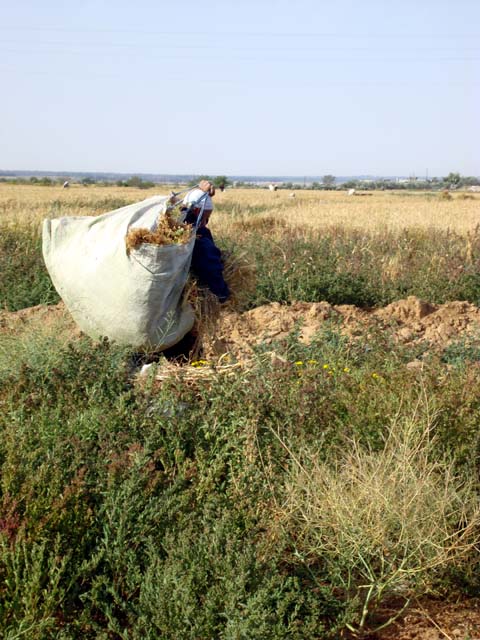
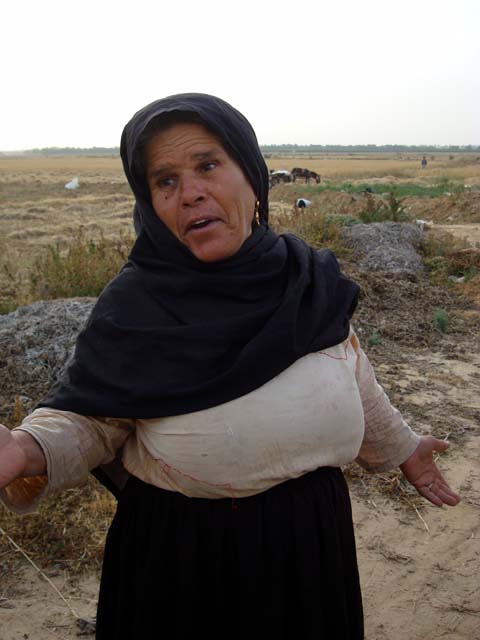
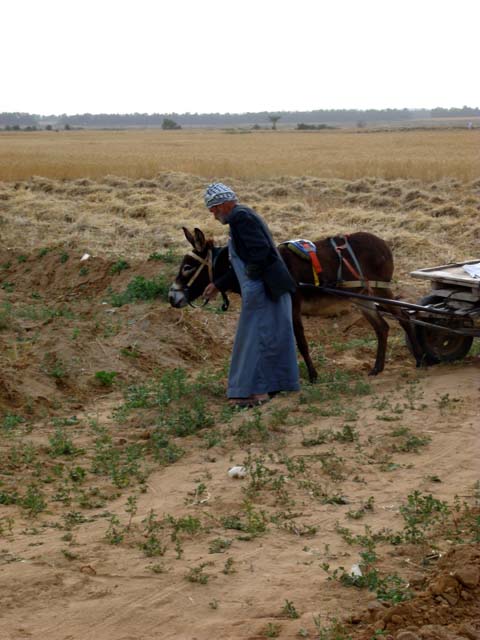
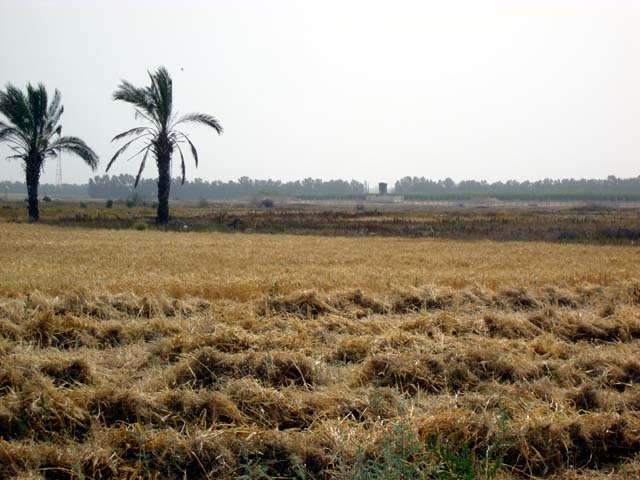
·At approximately 09:30, IOF troops positioned at the border between the Gaza Strip and Israel to the east of Deir al-Balah City fired at farmer Tawfiq Abdul ‘Aziz Abu Mgheisib, 44, who was working his land, 400 meters to the west of the border with Israel. Abu Mgheisib was not hurt; however, four residential houses in the area were partially affected. All the affected houses belong to the Abu Mgheisib family.
·At approximately 11:20, IOF soldiers positioned at Beit Hanoon (Erez) Crossing, in the north of Beit Hanoun town, directly fired at two World Vision (WV) employees. One of the two persons is Palestinian, Kamal Mohammed Moheisen, 32, and the other is Japanese, Kanjero. According to statements given by Kamal Mohammed Moheisen, the two persons drove to Beit Hanoun Crossing because Kanjero was informed that he had coordination to depart from Gaza via the crossing. While the two men were stepping down from the WV vehicle they used, they came directly under IOF fire. They were forced to flee and hide behind a cement block in the area. IOF continued firing for 15 minutes at the vehicle and at its vicinity. Front and back windows of the targeted vehicle smashed. The two men phoned the WV director who told them to withdraw from the area. Kanjero was forced to hold his hands up, with his shirt with WV logo on it, till they could leave the area.
Gaza, April 17, 2009 (Ramattan) – The Israeli army opened fire on Friday towards a rally of international pacifists in supporting for the Palestinian farmers north of Gaza, Ramattan reporter said.
"While we were filming the international peace activists helping the Palestinian farmers in Bait Hanon city, the Israeli soldiers opened heavy fire at us," Ramattan reporter indicated.
No injuries or damages were reported.
Earlier on Thursday, the Israeli warplanes struck a Palestinian empty house in the central Gaza Strip, no causalities were reported.
Israeli troops fire on Beit Hanoun NGO workers, farmers
Date: 17 / 04 / 2009 Time: 12:46
[Ma'anImages]
Gaza - Ma’an - Israeli forces opened fire on members of an international solidarity NGO in the northern Gaza Strip town of Beit Hanoun Friday morning.
The NGO, called Local Initiative, sent members on a mission to observe and assist a wheat harvest in the northern Gaza Strip. When they neared the wheat fields abutting the border fence Israeli troops opened fire.
Members of the NGO said no one was hurt, but the harvest has been aborted.
The initiative sought to collect local resources as crossings into the Gaza Strip have been letting a minimum of aid and consumer goods into the area since the Israeli war on the area. The aid has slowed to a trickle during the Jewish Passover holiday.
Israeli Occupation Forces open fire on International Solidarity NGO members
Saturday, 18 April 2009 04:21 added by PT editor
Gaza, April 17th, 2009 (Pal Telegraph) - Friday morning in the town of Beit Hanoun Israeli Occupation forces opened fire on members of the International solidarty NGO movement.
NGO members state there were no injuries, but the harvest they came to protect was aborted.
Known as the Local Initiative, the NGO sent members to observe and guard a wheat harvest in Northern Gaza. Israeli Occupation forces opened fire as they approached the wheat surrounded by an Israeli border fence.
The Initiative assists Palestinians in generating local resources to relieve shortages caused by the prolonged siege border closure inflicted on Gazans by Israel.
On a lovely, balmy day in southeastern Gaza, the breeze carries the delicious scent of new blossoms, birds bob as they fly, all is nearly-idyllic.
Fawzi, 13, is helping his mother, 5 other women, and 2 other men harvest lentils. He is a quiet and serious worker, intent on his task. I recall my own childhood of incomparable freedom and safety. I bore no responsibilities, and certainly never had to worry about being sniped while helping with any household chores.
Fawzi keeps his steady steam as the 2 Israeli snipers on a hilltop a few hundred metres away remained focused on the farmers in front of them. The Israeli military jeeps which patrol the border stop for long periods, observing the farmers. It was during one of these stops that the 2 snipers scurried up the low dirt mound to take position with their guns.
The farmers, including Fawzi, have little option but to continue their swift harvest: for some it is their income, for some their produce. But they’ve all been subject to Israeli soldiers’ firing in the same circumstances, and so are wary of the sniping that could break out at any second. Although the setting is near-idyllic, reality dictates a worried, frenzied harvest.
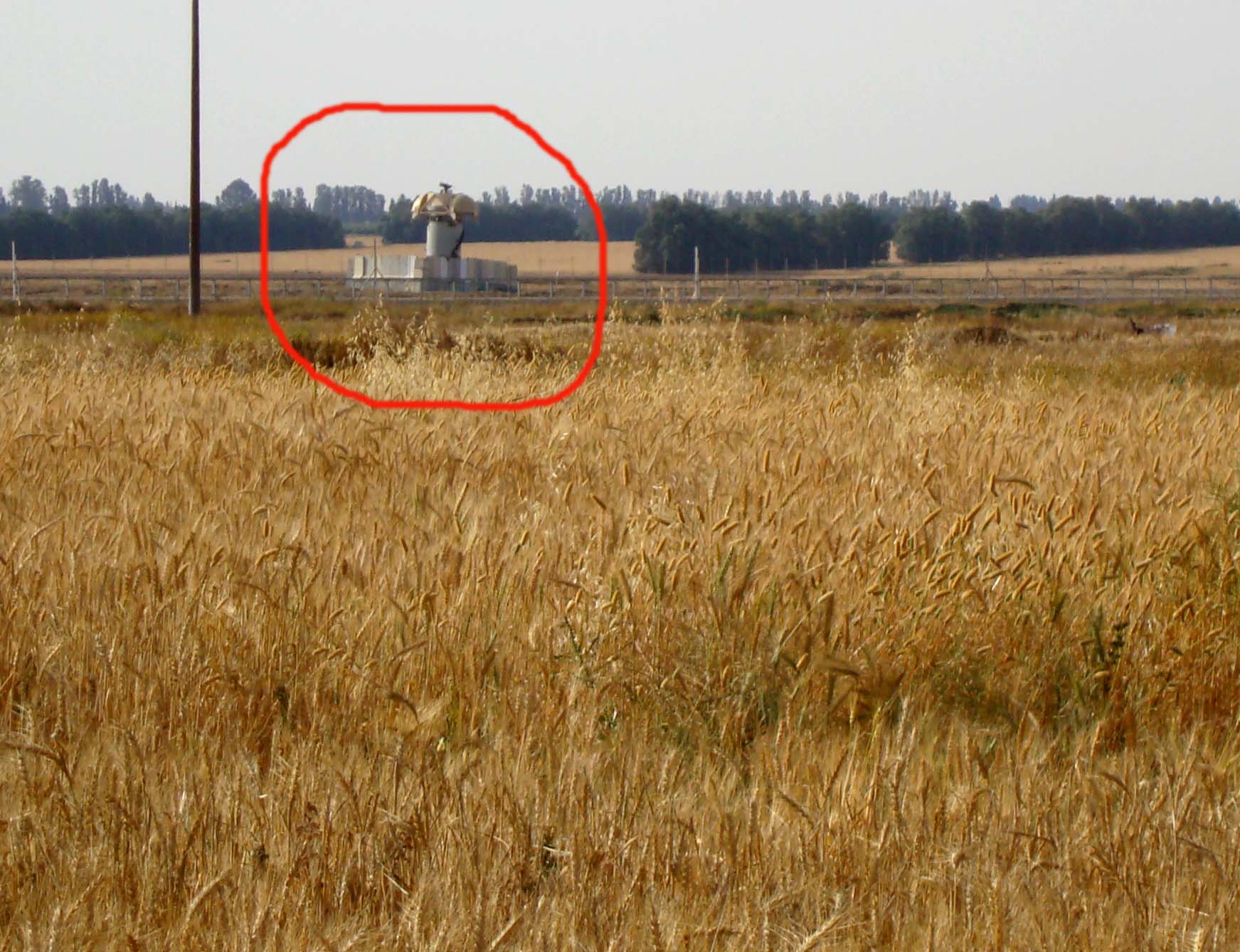
An Israeli military tower some hundred metres beyond in a different direction has opened its dome, sprouting a camera and unseen gun. Shots are being fired further south along the border, and its not possible to know whether they are coming from this tower or soldiers further along the fence.
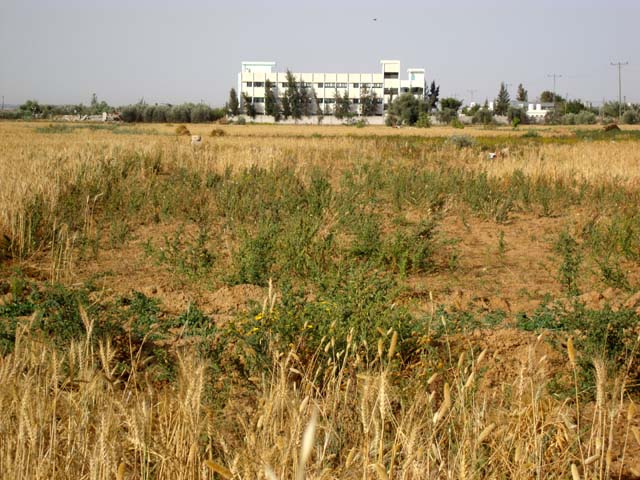
To our west are the ruins of a house where farmers shared tea with us before Israel’s war on Gaza. To our south is a school routinely subject to the same Israeli soldiers’ terrorizing. The students, we have been told, are often unable to complete a day of classes, interrupted by the shooting at or near the school.
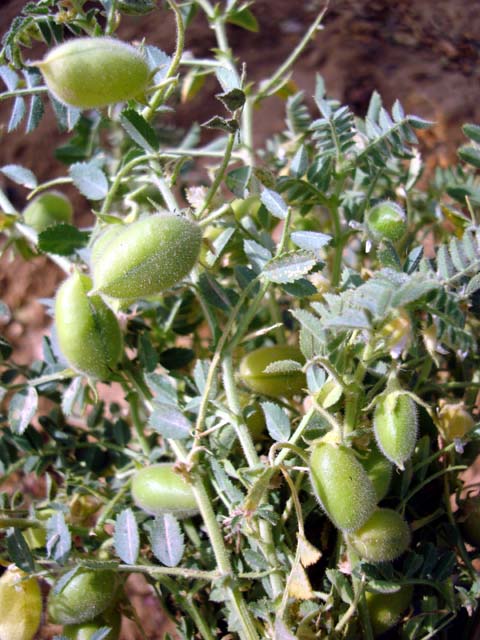
The farmers are working together, harvesting one field and moving to the next. We move from lentils, past a clump of chickpea plants (where I see my first fresh chickpea, key to a staple food, hummous), beyond fields of wheat and rye nearly ready for harvest, and onto another field of lentils.
The day is without incident, aside from the unease of being in snipers’ scopes, and the farmers leave, hauling the lentil stocks in plastic sheets and sacks to waiting donkey carts.
April 13: al Faraheen, east of Khan Younis
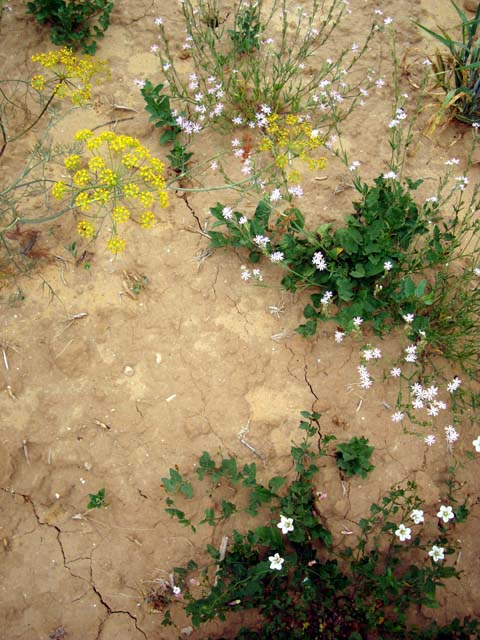
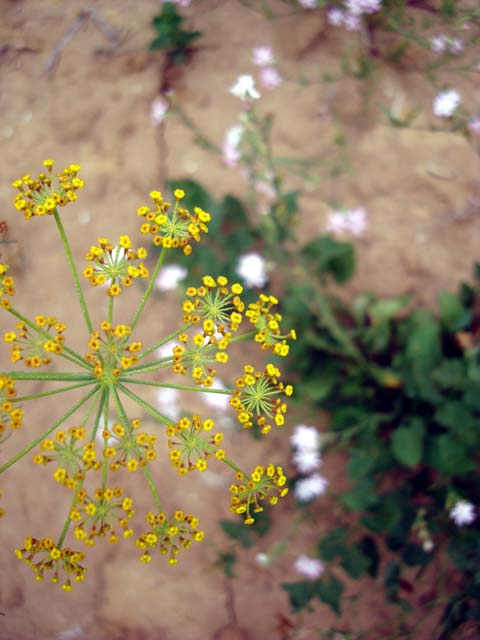
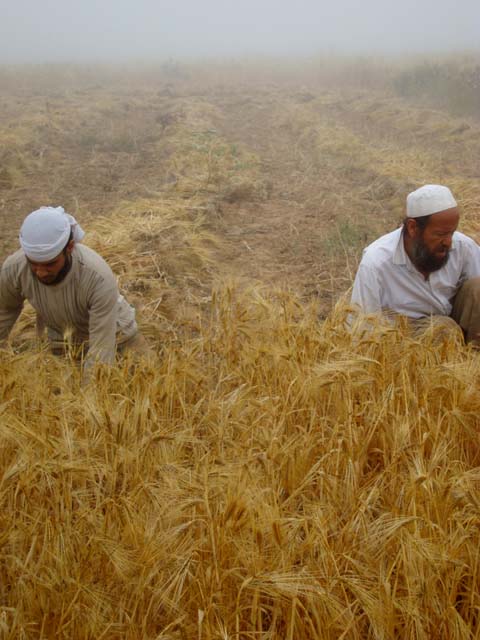
It is a foggy morning. As we drive up to the fields around 7 am, the fog has not lifted. The rye, wheat, dill, and random wildflowers glow brilliantly in the light cast by the thick fog. It’s not possible to see beyond 10 metres, though this clears a little after some time. We’ve walked south and east from a farm just under 500 metres from the border, so we know that we are potentially closer. Still, for the next 2 hours we cannot define where the border fence is, nor exactly from where to expect Israeli gunfire.
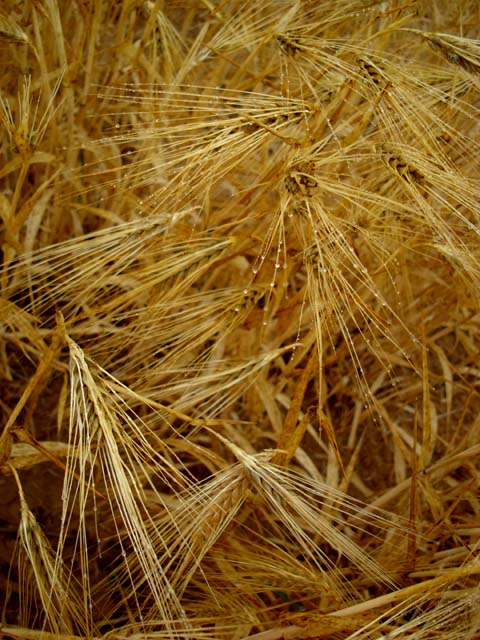
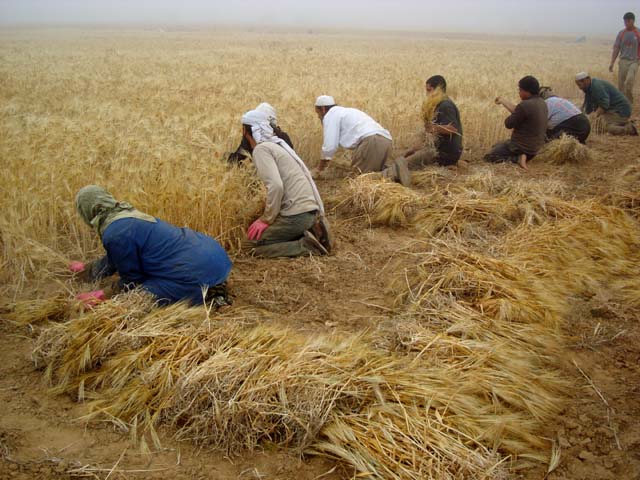
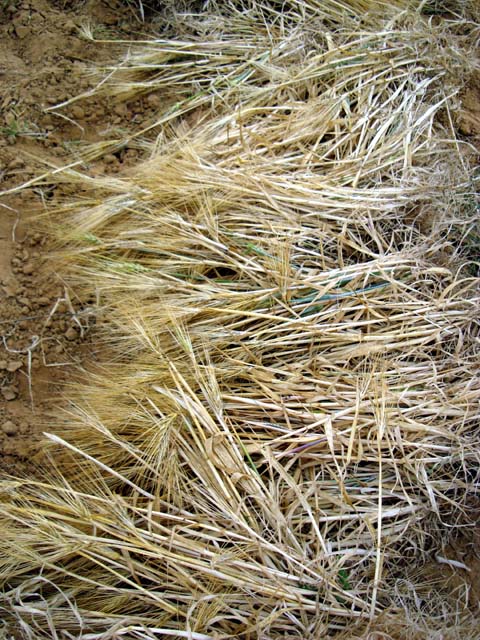
The farmers are working faster than any I’ve yet seen, gathering in clumps, with gloved or bare hands, the rough stalks of rye with such ease the plant seems like grass, not a hearty grain. The rye makes a loud crunching noise as it is felled. The farmers lay it in neat rows behind them, and if I hadn’t seen the harvest myself, I’d think the rows were the work of a machine.
They continue at this quick pace until the plot is harvested, rye piled and bundled and loaded onto a waiting horse cart. The fog has cleared enough to finally make out the line of the border fence, roughly 350 metres away. No jeeps were seen or heard for those few hours, and while harvesting in the murky fog was more nerve-wracking, the workers are relieved to have collected what they did.
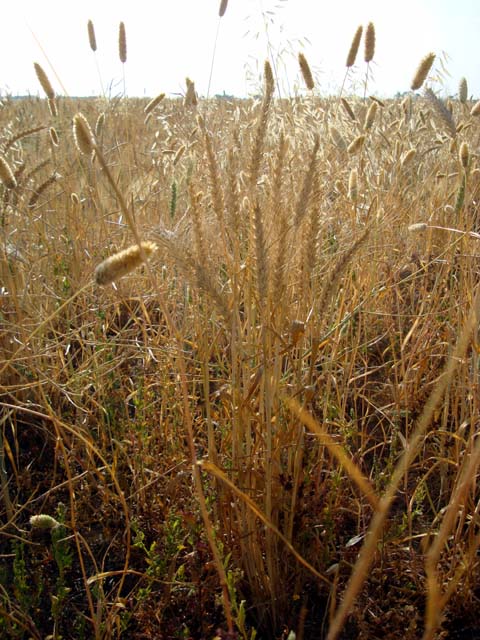
*stalks of wheat and rye
April 14: Lataamat, east of Khan Younis
“We’ve tried to harvest our rye for the last 4 days,” says Latifa Abu Taima(52). “Everytime we’ve come here, the Israelis have shot at us. There are 22 children in my family, with my children’s children. How are we supposed to feed them when we can’t work our land?”
It’s another successful harvest, though not without threat. Two Israeli jeeps, after watching from the border fence road, decide to pull up onto two dirt mounds on either side of the Israeli military tower. The jeeps remain perched there for the duration of our harvest. As with when the jeeps parked directly across from us for a period of nearly 30 minutes, there is little to do but continue to harvest, knowing that we are clearly, visibly unarmed civilians, and that the soldiers can see this.
Some of these women have not worked since the month before, meaning their income for the last 2 months has been a staggeringly meagre 40 shekels (~$ 10), on which they’ve had to help support large families.
L with her broken foot from fleeing gunfire, & youngest child
Last night I was playing chess in the shisha cafe across from Al Quds Red Crescent, where I am sure to find a familiar face and where they seem to have got over me being a girl in amongst the shebab, when I got a text from the south. “Our friends J and L were trying to fix the asbestos sheeting on their farmhouse roof in Faraheen today…” it began.
I knew immediately that this message wasn’t going to end well, and it didn’t. Apparently at 12 midday, 3 jeeps stopped, and soldiers opened fire from one on J and L up on the roof of their own home, firing about ten bullets. J and L tried to escape quickly down the stairs; and L, who has a bad right leg, fell, breaking one of the metatarsal bones in her left foot. Now she has a heavy plaster cast all the way from her toes to her knee.
When E and I visited them this morning in the rented house in the village, L was looking immobilised but determinedly cheerful, and sent us off to check on J, working at the farmhouse (being a farmer, he has little choice)having already been under fire again today. Assuming the Israeli soldiers cared enough about who they are shooting at to bother checking, they would be able to confirm that J worked for years as an engineer (in fact as an inventor if we understand correctly) half of every week in Israel. He is no threat to them, unless by his mere existence as a nonviolent Palestinian who loves his land.
J and L's oldest daughter R, with the peace mural on their farmhouse wall
I asked J something I’d always meant to - how L’s right leg was injured. It is twisted in a way that gives her an extremely pronounced limp, and I’d guessed it had been that way since birth. I was wrong.
During the First Intifada (Resistance to Israeli occupation), there had been a nonviolent demonstration in L’s village, beside her school, and the schoolchildren took part. L was 15. When Israeli soldiers started shooting tear gas into the crowd, L apparently decided they clearly couldn’t be trusted with weapons. She and her friend Asan walked up to the nearest soldier, confiscated his M16 and threw it to the ground. A second soldier immediately killed her friend and shot L in the leg. Considering how I finished my second last blog post, this story really had me looking at L with new respect. I thought about it; at half my age, she actually did it.
L's daughter R seems interested in a career of...whatever it is we do exactly...
J insisted on driving us back to the village house, with his two little daughters, in the rickety trailer of a tiny tractor, one of the few working pieces of machinery recent attacks have left him. I kept being convinced I was about to tumble out. “I’m too old for this sort of thing,” I said. “I only got in because he winked!” replied E. “As the actress said to the bishop,” I muttered, clinging on.
We drank tea, fielded the usual plans to get us married off to the locals to keep us firmly in the country, and then left for our next appointment, determined also to find L some crutches, because she can’t stand on either leg alone. Initial enquiries suggest this is something else there is a shortage of, especially since the war. The only option might be to buy her a pair, if we can even find any.
Leila Abu Dagga, along with her husband Jaber Rjila, was only on the roof of her house for a few minutes before the Israeli soldiers started shooting.
“It was just after 12 noon,” Rjila said. “We were trying to move the asbestos tiles on the roof to cover some holes,” he explained. In May 2008, the farmhouse, just under 500m from the border, was severely damaged by invading Israeli soldiers. In tanks and bulldozers, the Israeli soldiers razed the farmland and fruit and olive trees, also destroying the chicken barn and 2500 of the 3000 chickens within. Soldiers also destroyed two tractors, other farm equipment, and much of the house’s infrastructure.
During Israel’s war on Gaza, the Rjila house sustained further damage from Israeli shelling and shooting, including the asbestos tiles covering the house and chicken barn.
After each attack and the many shooting incidents from the border, Jaber Rjila has patched and mended his broken home, determined to live in it.
On April 10, the couple attempted to repair the roof enough to move back in with their 6 children. Since November 2008, when the Israeli soldiers’ shooting from the border became dangerously unbearable, the family has been living in a rented house in town. With 6 kids to feed and their school expenses, the house rental (~$100/month) is too much for the no-income family.
“After about 5 minutes, we saw 3 Israeli army jeeps appear along the border. One jeep pulled up onto a slight rise and parked. The soldiers began shooting at us. We ran to the stairs, and as we were trying to escape, Leila fell down the stairs, breaking her foot,” Jaber Rjila recounted.
Leila Abu Dagga has walked with a limp since she was 15, when she was shot in her right leg by Israeli soldiers at a demonstration during the first Intifada. “Three Israeli jeeps came into the school grounds and soldiers began throwing tear gas at the students,” Rjila said. “Leila ran up to one soldier and tried to knock his gun down, so he wouldn’t shoot the students,” he continued. “A second soldier turned his gun on her and shot.” Leila survived with a bad leg and her friend was martyred.
She wasn’t hit by Israeli soldiers’ bullets yesterday, but her broken foot is a direct result of their shooting. Others have been less fortunate, including farmers and civilians killed and injured while working on their land, or simply while living on it.
“We took her to Khan Younis’ Nasser hospital,” Rjila said, gesturing to his wife’s cast-covered foot. “She was treated, but we didn’t get crutches. We don’t know why.”
Calling around later to find crutches for Abu Dagga, it becomes clear that there is a shortage of them in some hospitals. The crutch trail has led to a few possible sources which, if open tomorrow, could ease Leila Abu Dagga’s coming weeks of rehabilitation. With her right leg already long-injured and the fresh injury to her left foot, she faces a drawn-out period of immobility.
The contrast of life in the ‘buffer zone’ –where the Israeli military can shoot, maim, and kill at will, and where the Israeli army destroys farmland and barns without repercussion –to that of agricultural land elsewhere in the world is stark. Each act of non-violent resistance, of living and life, becomes a gargantuan task with the odds stacked against the farmers and civilians who face the world’s 4th most powerful military. Farming encompasses a whole new depth of resistance in the Israeli-imposed ‘buffer zone’.
In the “buffer zone”, created and expanded by Israel [the now 1 or 2 km band of land running along on Gaza's side of the border, from south to north and northeast to northwest], it is literally hit and miss whether farmers and civilians will be maimed or killed by the Israeli army on any given day.
On April 5th, farmers harvesting lentils in Khoza’a were, surprisingly, not shot at. Two Israeli jeeps lingered an uncomfortably long time, honking and flashing their headlights at the farmers. We were able to stand with the farmers as they swiftly swept the land clean of lentil stocks.
Although relieved no shots had been fired this time, the duration of the time harvesting was stressful, no matter how resilient the farmers are in their determination to keep working their land. In an ideal world, their greatest worries would be the weather or having the right equipment.
The next day, and again 3 days later, however, in al Faraheen a couple of km further north along the border area, farmers and internationals accompanying them were again subject to fire, dangerously close fire.
*Leila and Jaber, November 2008, photo: Donna Wallach
Today, Jaber Rjila and Leila abu Dagga returned to their house just under 500m from the border to repair something on the roof. Following the extensive Israeli army invasion in their region in May 2008 which destroyed their chicken farm and much of their farming equipment, along with hundreds of olive and fruit trees, the couple and their 6 children had not been living in the house, instead renting one in town. Jaber had periodically slept in the house until November 2008 when the Israeli soldiers’ shooting became too much. He abandoned it for the time, returning only during daylight hours to tend what crops he was still able to grown.
Leila abu Dagga has long had a severe limp, making walking very difficult and tedious for her. Yet she was active around the farm and house, doing what was necessary, at a slower pace but with great energy.
When they returned to their home today, Rjila and abu Dagga were all to aware of the Israeli soldiers’ policy of shooting at civilians in the “buffer zone”. But while wary, the couple is determined to keep their home and work their land, in spite of what is clearly a methodical Israeli policy from the top-down to empty-out Gaza’s border areas. [see: Suddenly, Home Was Gone
"They told me our house was now in a closed military zone," Manwa said. "They said it was a 'decision from the top' and that we had to leave immediately and walk towards Gaza. I refused, and tried to negotiate with them for time to gather our belongings. They refused."]
They’d gone up to the roof to repair one of the many things damaged or destroyed by repeated Israeli shooting over the months when Israeli soldiers began to shoot. In trying to escape down the stairs, Leila fell, breaking her leg.
On the phone hours later, after her rush to the hospital, Leila said she’d be okay. “At least they didn’t kill me,” she said, with an alhamdilliah [ 'thanks be to God'].
*simple but effective means of transporting harvested lentils.
*wheat, nearly ready for harvest, delicious while green.
Israeli bans on access to agricultural land near the border and fishing zones continue During the reporting period, Israeli forces continued to open fire on Palestinian farmers and fishermen. Several houses sustained damage when Israeli forces opened fire on farmers east of Al Maghazi Camp, forcing them to leave their land. In addition, Israeli patrol boats opened-fire on six occasions towards Palestinian fishermen enforcing the limitation of the fishing zone to three nautical miles. According to Al Mezan human rights centre, on 6 April, Israeli patrol boats opened fire on a fleet of Palestinian fishing boats carrying 60 fishermen. During the incident, Israeli patrol boats detained ten fishermen, including two children, and confiscated their boats. The fishermen were released the next day. No injuries were reported.
This morning, the farmers from Al-Faraheen in the Gaza Strip persisted with their efforts to harvest the year’s crop of lentils. Volunteers with the International Solidarity Movement, and a camera crew from Press TV accompanied the farmers as they set out to work in a field about 300m from the border.
Before the farmers reached the field, an Israeli jeep stopped next to the border fence several hundred metres away. A number of shots were fired in the direction of the farmers before the jeep drove away.
After an hour as the farmers were about to finish their work, another jeep stopped at the border. Soldiers got out and took up firing positions. An ISM volunteer then spoke to them with a megaphone - informing the soldiers that they were all civilians, and requesting that the soldiers did not open fire.
The soldiers then fired several shots at the farming group. The proximity of some of these shots to the farmers was marked by an audible hiss and crack as they ripped through the air past their heads. At this point the farmers decided to leave.
Caoimhe Butterly from the ISM and the Free Gaza Movement said “Today’s action was further evidence of the systematic attacks that border farming communities face. Yet despite this, to sustain their families, farmers must put their lives at risk every day in order to cultivate their land. These acts of popular resistance demand our support. There needs to be continual support in the form of sustained campaigning and action on the issue.”
The Israeli military is attempting to enforce a no-go zone on the Palestinian side of the border. As part of this ongoing project, and in addition to shooting at the communities that live and work in the area, the Israeli military has destroyed large swathes of olive groves, orchards, and other arable land, and hundreds of homes.
This is a blog about Gaza farmers, workers and all the civilian population living in Gaza Strip rural communities along the Green Line, suffering from daily Israeli attacks and resisting the implementation of a so called "buffer zone" by the Israeli Occupation Forces.
Note: this blog is focusing on Israeli attacks on civilians inside or around the so called "buffer zone". Attacks on resistance fighters, or attacks, usually airstrikes on civilians further inside the Gaza Strip, or along the Egypt border (apart from the eastern areas such as Al Shoka or the airport area) are usually not mentioned. For the attacks of the Israeli Navy see http://fishingunderfire.blogspot.com/
Cases of children shot whilst collecting building material or working near the border fence between the Gaza Strip and Israel
OCHA: BETWEEN THE FENCE AND A HARD PLACE - SPECIAL FOCUS, August 2010
THE HUMANITARIAN IMPACT OF ISRAELI-IMPOSED RESTRICTIONS ON ACCESS TO LAND AND SEA IN THE GAZA STRIP (click on image for the full report in PFD)
Al Haq: Shifting Paradigms - Israel’s Enforcement of the Buffer Zone in the Gaza Strip
List of Palestinian farmers & other civilians shot in Gaza Strip’s rural communities
List of Palestinian farmers & other civilians shot in Gaza Strip’s rural communities since the declaration of the ceasefire on the 18th of January 2009 - till September 2009 (click the image)